
A Khaki Campbell can lay more eggs a year than an average laying hen — 250–300. But only if she’s fed like a layer, not like a duck left to forage. On grass and grain alone a duck lays a few dozen eggs, and only in spring. The good news: feeding a duck for eggs is no harder than feeding a hen — you just need to know four differences.
How much a duck eats
A duck is bigger than a hen and eats more: a laying-breed duck in lay eats 120 grams of feed a day or more, depending on production; on range with a pond, grass, snails and duckweed replace part of it.
| Age | Protein | Calcium |
|---|---|---|
| Ducklings 0–3 weeks | 20–22% | 0.8–1% |
| Growers 3–16 weeks | 15–16% | 0.8–1% |
| Pre-lay, 16–20 weeks | 16% | 2–2.5% |
| Duck in lay | 16–18% | 3–3.5% + free-choice oyster shell |
Benchmarks for laying breeds; meat ducks lay less and get fat easily on layer feed.
Can you use chicken feed?
For adult laying ducks, yes — layer feed for hens works if you offer oyster shell separately and don’t let them get fat. Ducklings are trickier:
- Niacin. Ducklings need almost twice as much as chicks. On chick feed, ducklings often limp and are unsteady on their legs. The fix is a dedicated duckling starter or brewer’s yeast at 1–2 tablespoons per kilogram of feed.
- Medicated chick feed. Ducklings eat more and get more of the drug. Use it only if your vet is fine with it.
- Pellets, not mash. Ducks wash down every mouthful. Fine mash sticks to the bill, clogs the nostrils and ends up in the drinker.
Feed and water go together
A duck needs water to swallow feed and clear her nostrils. Put the feeder near the drinker, but not over the water: wet feed sours within a day. The drinker should be deep enough for the duck to dip her whole bill. Water is covered in detail in water for ducks.
When ducks lay
Ducks lay early in the morning, usually before 7–9 a.m. Let them out to the pond at dawn, and the eggs end up in the grass and in the water. So in the morning: nest and feed indoors first, then out to range.
- 14–16 hours of light a day keeps them laying in winter;
- an evening feed trains them to come back to the duck house;
- oyster shell in a separate feeder, so each duck takes what she needs.
Don’t overfeed
A fat duck lays worse and more often gives double-yolk and soft-shelled eggs. If the ducks are on good grass, you can cut complete feed by a quarter — but watch production: if it falls, you’ve cut too much.
Ducks in your records
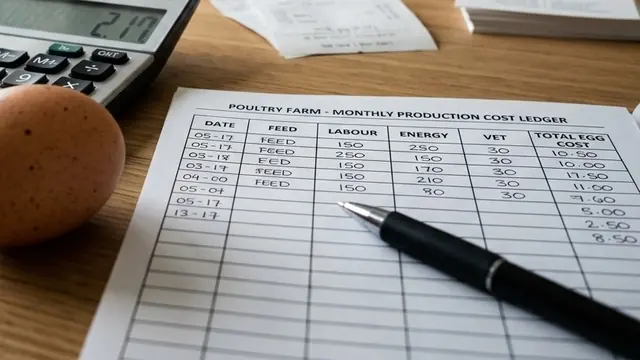
In EggPulse a duck house is tracked the same way as a chicken house: eggs, feed, mortality. Laying percentage and feed per 10 eggs show whether range pays off and what a duck egg costs you. Which duck breeds lay best is in the laying duck breeds article.