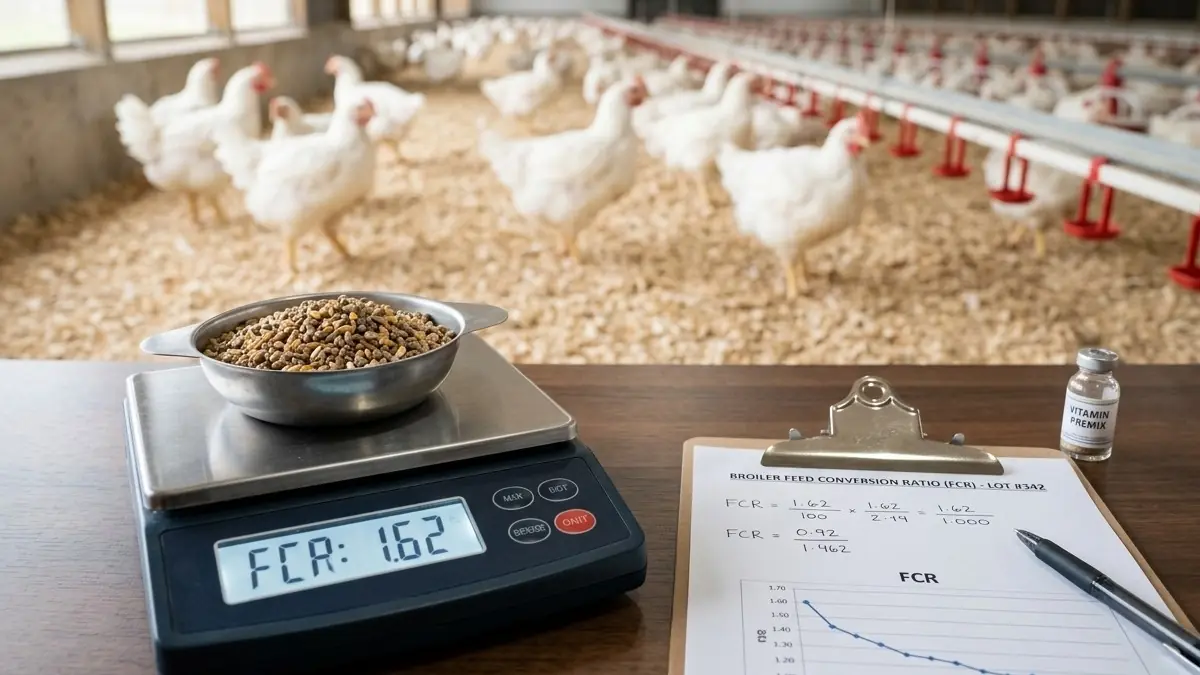

With meat birds, feed eats most of the budget. So the main question is simple: how many kilograms of feed do I spend to grow a kilogram of bird? The answer is called the feed conversion ratio, or FCR. It sounds fancy, but it takes one step to calculate.
The FCR formula
FCR = feed eaten, kg ÷ live weight gain, kg
The smaller the number, the better. An FCR of 1.7 means the birds ate 1.7 kg of feed to gain a kilogram of live weight.
Example
A house of 1,000 birds. They were fed 5,200 kg over the batch, total weight gain 3,000 kg.
| Metric | Value |
|---|---|
| Feed for the batch | 5,200 kg |
| Weight gain | 3,000 kg |
| FCR | 5,200 ÷ 3,000 = 1.73 |
For modern crosses at 5–6 weeks, around 1.6–1.8 is considered normal. But every cross has its own table and that is what you should check against: it is in the breeder’s management guide.
Where the feed goes
If your FCR is worse than expected, the feed did not vanish without a trace. It leaked somewhere. Here are the five most common places:
- Spillage and rodents. Feeders hung too high or too low, holes in the store — and a few percent ends up on the floor and in burrows.
- Temperature. In winter birds burn feed to keep warm; in summer heat they eat less and grow worse.
- Disease and mortality. A bird that died already ate, and there is no weight gain from her. The feed is written off, the result is zero.
- Quality and storage. Damp or moldy feed is digested worse and can even do harm.
- Inaccurate weighing. Weigh three birds near the door and you get a random number. Take 50–100 birds from different parts of the house.
Calculate FCR every week, not just at the end of the batch. Then a worsening shows before the money is already lost.
So you don’t keep it in a notebook
In EggPulse, daily feed, weighings and mortality are recorded per batch, and the conversion is calculated automatically. You see it by period and notice the moment the result went the wrong way.