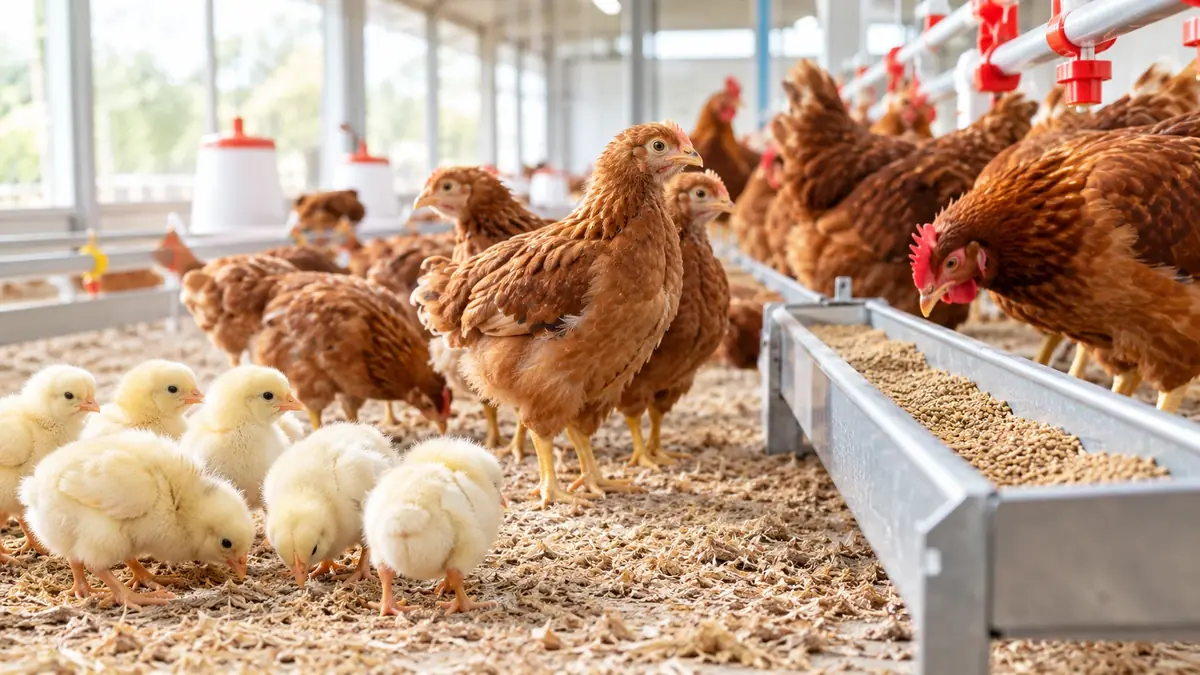

A brooder is just a warm corner where chicks live for their first weeks. You don’t have to buy one: a good brooder can be built in an evening from plywood or cardboard. What matters isn’t the material but that it’s warm, dry, draft-free and safe from fire.
Size
| Age | Chicks per m² |
|---|---|
| Week 1 | 25–30 |
| Week 2 | 20 |
| Weeks 3–4 | 12–15 |
Ducklings and poults are bigger and grow faster, so they need more room; quail chicks need less. Build the brooder with room to spare, or so it can be extended.
Shape and material
- No corners. Chicks pile up in corners and crush each other. For the first days a round ring of cardboard or hardboard 40–50 cm high is best.
- Solid walls at the bottom — protection from drafts at chick level.
- Mesh on top — so older chicks can’t jump out and cats can’t get in.
- Washable surfaces, if the brooder will be used more than once.
Heating
| Option | Pros | Cons |
|---|---|---|
| Infrared heat lamp | Cheap, easy to adjust by height | Fire risk, fragile, light around the clock |
| Ceramic heat emitter | No light, long-lasting | Gets very hot, needs a ceramic socket |
| Heat plate (“electric hen”) | Safe, low power, chicks sleep in the dark | Costs more, height must be adjusted as they grow |
A 250 W lamp is hung about 40–50 cm above the bedding and raised as the chicks grow. Check the temperature not by the lamp but with a thermometer at back height and by the chicks’ behavior — see the first two weeks.
Hang the lamp on a chain or wire, never by its cord. Fit a guard. Keep at least 30–40 cm between the lamp and bedding, walls or cardboard. Plug it into a sound outlet, not a daisy-chained power strip. Brooders with heat lamps catch fire more often than you’d think.
Warm and cool zones
Put the heat source off to one side, not in the middle. That gives a warm zone under the lamp and a cooler one by the opposite wall, and chicks choose for themselves where they’re comfortable.
What goes inside
- Bedding: 4–5 cm of coarse shavings; for the first days, paper on top with feed scattered on it.
- Drinkers: shallow so a chick can’t drown, at the edge of the warm zone. For ducklings — ones they can dip their bills into.
- Feeders: low trays, then troughs.
- A thermometer at chick height.
Cleanliness and air
Replace wet bedding by the drinkers daily. The brooder needs fresh air, but no draft at floor level. A sharp ammonia smell means it’s time to clean and expand. After each batch, wash and dry the brooder; a cardboard ring is simply replaced.
The brooder in your records
A batch in the brooder is easy to track from day one: in EggPulse you log temperature, mortality, feed and weight, and they show how the start went. The next batch can be compared with this one to see what changed.