
Most flock losses happen not in month seven but in the first ten days. A day-old chick can barely warm itself, lives off the last of its yolk, and pays quickly for every mistake: a cold drinker, a draft, a heat lamp hung “by eye.” The good news is that a lot can be fixed, if you know what to watch.
Before they arrive: the brooder must be ready
Switch the heat on 12–24 hours before the chicks come. You need to warm the bedding and the walls, not just the air: if they are cold, the chick gets chilled from below even when the thermometer says all is well. Bedding should be dry and low in dust, 4–5 cm (about 2 in.) deep. Coarse shavings or chopped straw work; fine sawdust gets swallowed. Put out feed and water in advance, and use water at room temperature, not straight from the well.
Temperature by day
Measure at chick-back height, not near the ceiling. Guidelines for chickens and broilers:
| Age | Under the heat, °C | What to do |
|---|---|---|
| Days 1–3 | 33–35 | Light almost around the clock, feed and water next to the lamp |
| Days 4–7 | 31–33 | Gradually widen the warm zone |
| Week 2 | 28–30 | Drop 2–3 degrees a week |
| Week 3 onward | 25–27, then 21–23 | Let feathering guide you |
If you are raising ducklings, quail chicks or goslings, the numbers differ, so check them against guidance for your species.
The thermometer can lie. The chicks don’t
Half an hour after placing them, watch the birds. The picture says more than any gauge.
- Huddled under the lamp, peeping. Too cold. Lower the lamp or add wattage, and close any gaps.
- Scattered to the walls, beaks open, wings held away. Too hot. Raise the lamp.
- Spread out evenly, walking, eating, sleeping. Exactly right.
- Crowded to one side. There is a draft from the other. Find it with your hand.
Water and the first feed
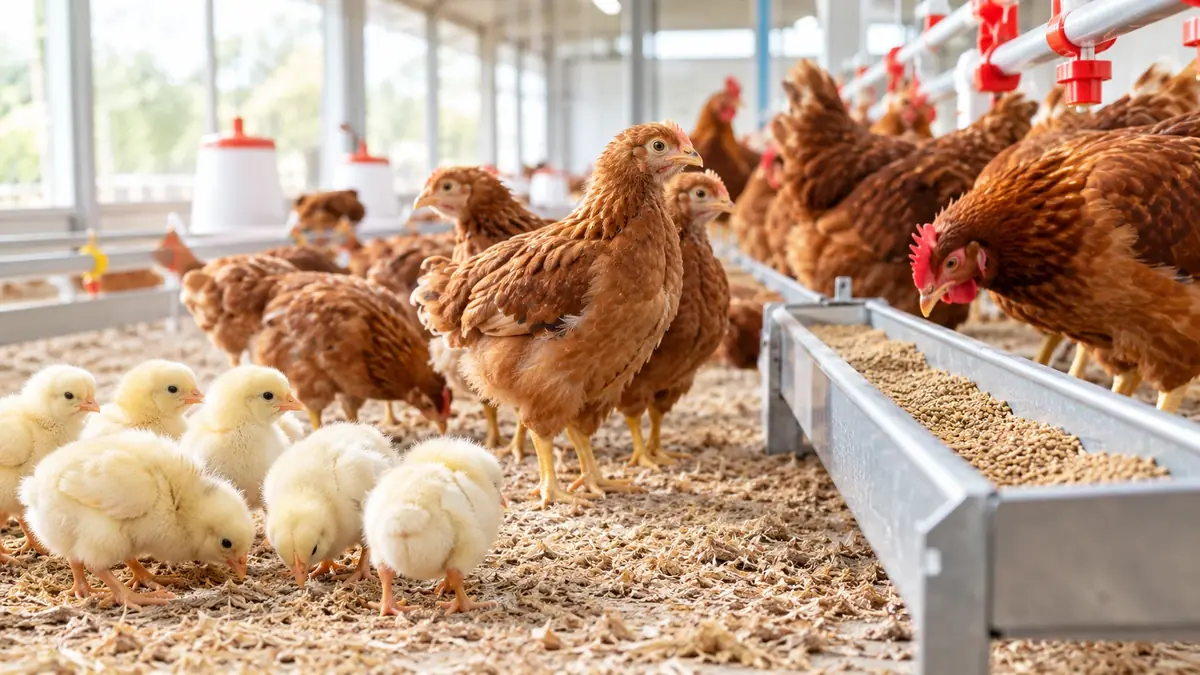
Water comes first. Many chicks don’t realize right away that the drinker is for drinking, so pick up a few and dip their beaks. Choose drinkers a chick can’t climb into, because a wet chick chills in minutes. After 8–12 hours, feel the crops of about ten birds. A fed chick has a soft, warm crop like a tiny pouch. If most are empty, the chicks haven’t found the feed, or it is too cold for them to walk to it.
Give starter feed as crumbs. On day one you can scatter it on paper or cardboard on the floor so it’s easy to spot. Then move to feeders, and never leave the chicks without feed, even overnight. How much to give each week is in our feed norms article.
Crowded or fine
In week one, 25–30 chicks per square meter is tolerable, but by week two or three it’s time to thin them out. They grow fast, bedding gets damp, and ammonia and humidity climb with it. Your nose is a good instrument here: if the brooder smells sharp, you are already late cleaning. More on humidity and gases in poultry house climate.
What to record every day
- Mortality. For week one, up to 1% of the chicks received is normal. At 2% or more, look for the cause immediately.
- Temperature, morning and evening.
- Feed and water use. A sudden drop is the first sign of trouble.
- Weight. On day seven, weigh 20–30 chicks from different corners. A broiler should be around 170–200 g by then, more than four times its starting weight. Layer breeds are lighter, so check the breeder’s figures.
If daily losses jump two- or three-fold, the chicks are listless and huddled with puffed-up feathers, or you see diarrhea or noisy breathing. Don’t wait until tomorrow: in chicks, disease moves in hours.
So the records don’t get lost
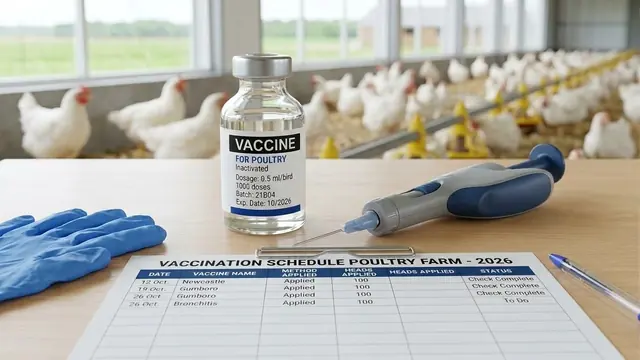
In EggPulse, mortality, feed and weigh-ins are logged per house and batch, and losses are worked out as a percentage automatically. You can log standing at the brooder, with no signal. Vaccinate young birds by the vaccination schedule.