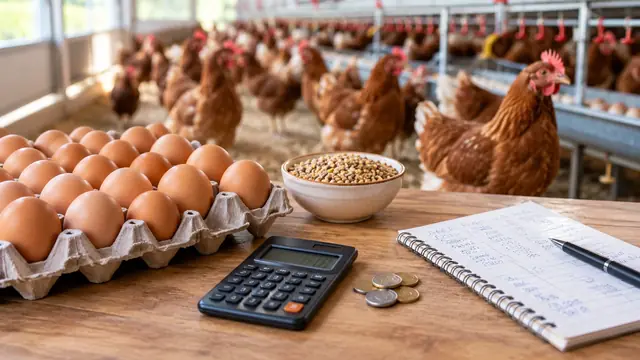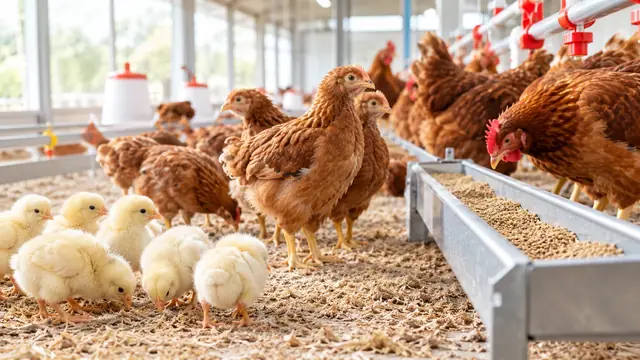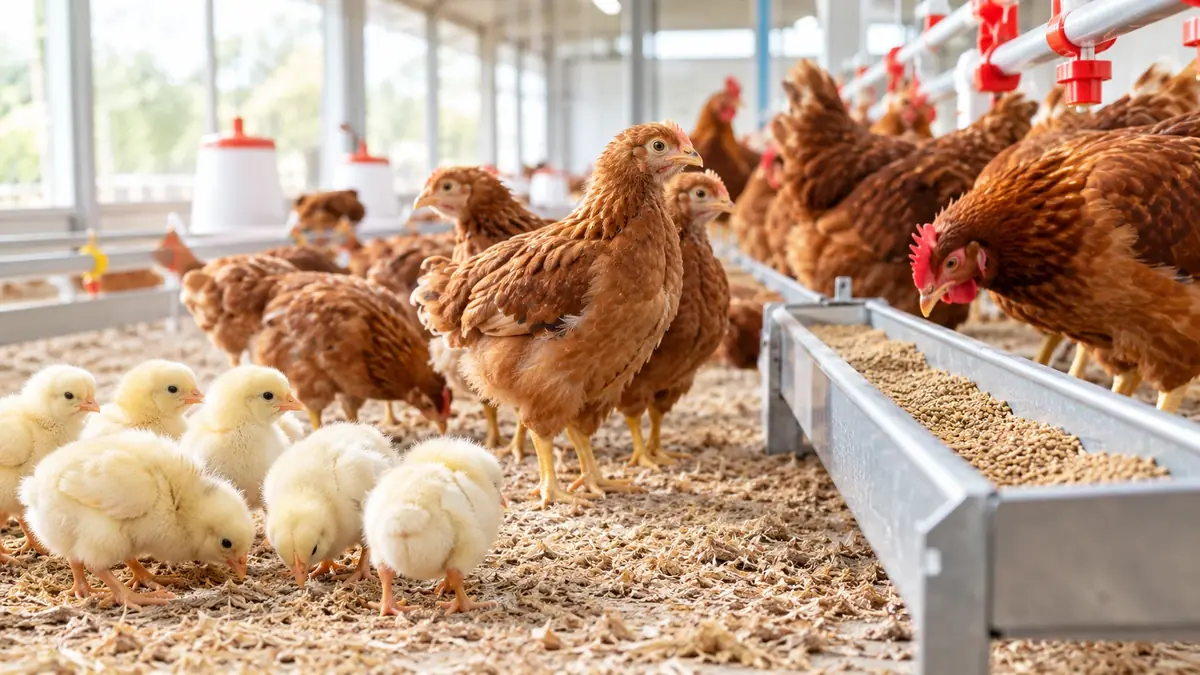

“How much feed should I give?” is the most common question from beginners. The short answer: an adult laying hen usually needs about 110–125 grams (roughly 4 oz) of complete feed per day. But the figure depends on age, breed, temperature and the feed itself. Below are benchmarks and a way to check that your flock is on track.
Benchmarks by age
| Age | Feed per bird per day, g | Feed type |
|---|---|---|
| 0–4 weeks | 10–40 | Starter |
| 5–8 weeks | 40–60 | Grower |
| 9–16 weeks | 60–90 | Grower / developer |
| 17–20 weeks | 90–105 | Pre-lay |
| Layer (from week 20) | 105–125 | Layer feed (with calcium) |
These are averaged benchmarks for egg-type crosses and breeds. Dual-purpose and heavy breeds eat more. For exact week-by-week norms, use the management guide from your cross’s breeder.
Calculating for the flock
| Laying hens | Per day | Per month |
|---|---|---|
| 10 | ≈ 1.2 kg (2.6 lb) | ≈ 36 kg (79 lb) |
| 50 | ≈ 6 kg (13 lb) | ≈ 180 kg (400 lb) |
| 200 | ≈ 24 kg (53 lb) | ≈ 720 kg (1,590 lb) |
Calculated at 120 g per bird. Add a 5–10% margin for losses and buy feed so it does not sit longer than 3–4 weeks: old, damp feed spoils.
What changes the norm
- Temperature. Birds eat more in the cold and noticeably less in the heat, and lay worse.
- Feed energy. The richer the feed, the less birds eat. Diluting complete feed with grain lowers the share of protein and calcium.
- Production. At peak a hen eats more than during molt.
- Feeders. If there is not enough space, weaker birds go hungry.
How to tell you are feeding right
- The feed is eaten within the day. If a lot is left, cut the amount; if the feeder is empty and birds look hungry, add.
- Weight is stable. Weigh 10 hens once a month. Obesity lowers production.
- Egg production holds without sharp dips that have no outside cause.
- Feed per egg. Divide the month’s feed use by the number of eggs. A typical benchmark for layers is about 130–160 g per egg. A noticeably higher figure is a reason to look for losses: spillage, rodents, excess feed.
Write down how much feed you put out and compare it with the egg count. In a couple of weeks you will have your own per-bird norm — more accurate than any table.
Without manual math
In EggPulse you enter feed use in the log, and the app shows consumption per bird and its trend next to the eggs. A sudden change is visible the same day. For meat birds, see the article on broiler feed conversion.