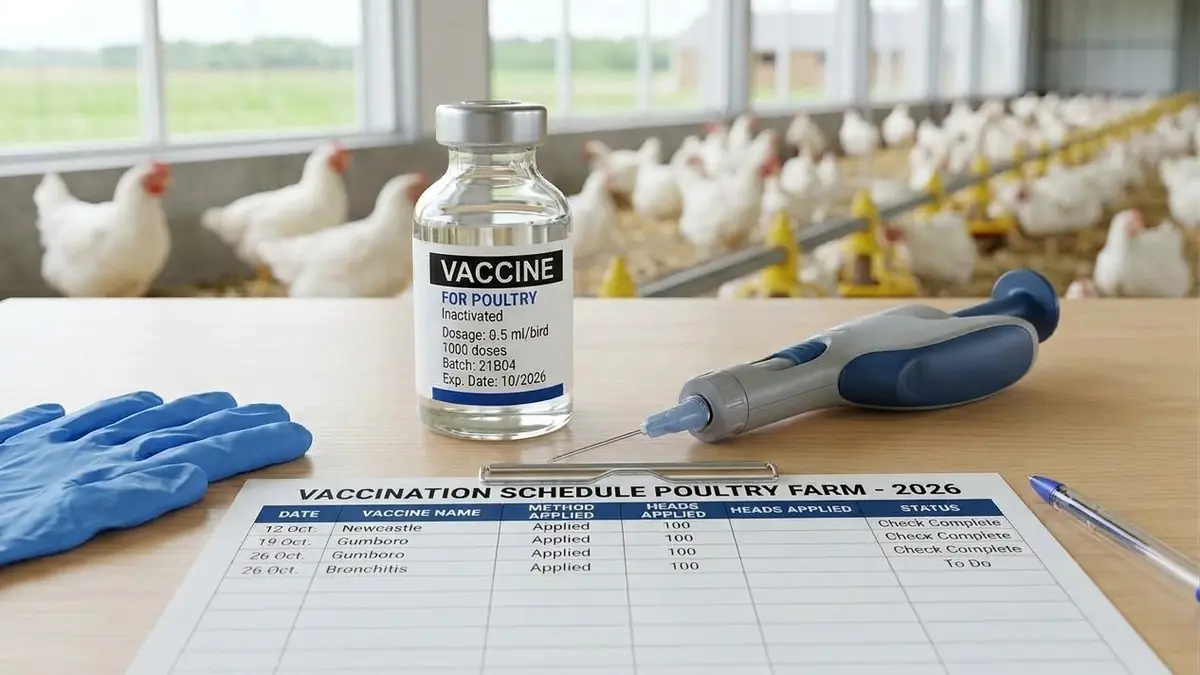

The vaccine is bought, the vet has written the program, vaccination day is here. You mix the vial, the birds drink — and a month later there's Gumboro in the flock anyway. Most often it isn't the vaccine. It was killed by chlorine in the water, a warm vial or rushing. Vaccination only works when every bird gets a live dose.
Which vaccines and at what age is the vet's decision (typical schedules by day). This article is about doing the vaccination itself. Always check doses, mixing and timing against the vaccine leaflet: it outranks any article.
Preparation
- Cold. Vaccine is stored at 2–8 °C, in a separate fridge with a thermometer. Carry it in a cool bag. Don't freeze it unless the pack says so.
- Doses rounded up to a whole vial. Count the birds and round up to the vial size. Never split doses "to make it stretch".
- Healthy birds. Don't vaccinate sick or weak birds without the vet's agreement.
- Clean equipment, no disinfectant. Chlorine kills a live vaccine, and so do disinfectant traces on buckets.
In drinking water
No need to catch birds, but it's also the easiest method to get wrong.
- Work out the water. The day before, measure how much the flock drinks in 2 hours. The vaccine water should be drunk within 1.5–2 hours. Faster, and not every bird gets some. Slower, and the vaccine may die in the water.
- Remove the chlorine. Stop water treatment in advance. Add skimmed milk powder to the vaccine water, about 2 g per litre, or the stabilizer from the vaccine maker. Wait 20 minutes, then add the vaccine (drinking water quality).
- Make the birds thirsty. Take the water away for about an hour. Not more than two hours: birds then crowd and fight at the drinkers.
- Mix the vaccine. Open the vial under water in a bucket of 1–2 litres, stir, and pour into the full volume.
- Drain the old water from the line. On a nipple line, about a litre for every 3 m, until vaccine water comes through. Only then lower the drinkers.
- Walk the house at least twice during vaccination: get the birds up so they all drink.
- Turn the normal water back on only when all the vaccine water is gone.
Stabilizers with a blue dye are handy: a stained tongue and crop show which birds drank.
Spray
Spray gives good local immunity against respiratory disease. Chicks drink unevenly in their first days, so live vaccines are often given to them by spray rather than in water.
- Day-old chicks. Coarse droplets, about 100–300 microns. Spray from 30–40 cm above the boxes, evenly, so all the chicks get wet. Keep boxes away from the heater. After 15 minutes, once the chicks are dry, let them out.
- Older birds. The finer the droplet, the deeper it goes into the airways and the stronger the reaction. Droplet size and sprayer type strictly by the leaflet and the vet's advice. Take special care in a flock with mycoplasma.
- Ventilation. Turn it down while spraying and dim the lights so the birds sit calmly. Then restore ventilation.
Eye drop and nasal drop
The most precise method for live respiratory vaccines: every bird gets its own dose. Some breeder company guides make it the main method for certain vaccines, such as laryngotracheitis.
- One drop in the eye (or the nostril — as the leaflet says).
- Hold the bird until the drop is absorbed. If it blinks and the drop rolls off, the dose is lost — give another.
- Keep mixed vaccine cold and in the shade, and use it within the time on the leaflet.
- Mark vaccinated birds with paint so none get a double drop.
Wing web
This is how fowl pox and sometimes avian encephalomyelitis vaccines are given. According to Hy-Line, most pox outbreaks in vaccinated flocks come down to poor technique.
- A two-pronged applicator needle is dipped in the vial every time.
- Spread the wing and pierce the web in the centre of the triangle, clear of blood vessels and bone. Not through feathers.
- Don't spill vaccine on birds or the floor: pox lesions can appear where drops land.
- After 7–10 days, check for "takes" in part of the flock: there should be a swelling with a scab at the site. The scab drops off in about 2–3 weeks. If many birds have no swelling, the vaccination failed — call the vet.
Injection
Inactivated (killed) vaccines are given only by injection: into the muscle or under the skin. Usually before lay starts, so immunity lasts the whole laying period.
- Warm the vaccine. Take an oil-based vaccine out of the fridge in advance so it reaches room temperature. Cold vaccine is hard to inject and more painful for the bird.
- Site as per the leaflet. In the breast muscle, inject into the thick part, not at the edge: at the thin edge it's easy to hit the liver. Under the skin — into a fold at the base of the neck.
- Needles. Change them about every 500 birds and with each new vial. A blunt needle injures; a dirty one carries infection.
- Don't rush. Common mistakes: pulling the needle out before the full dose is in, or pressing the plunger on the way out.
How to check it worked
| Method | What to check |
|---|---|
| Water | All water drunk within 1.5–2 hours; tongue and crop stained if dye was used |
| Spray | Chicks were evenly wet; a few days later, a mild reaction without rising mortality |
| Eye drop | Every bird marked, no drops rolled off |
| Wing web | A scab at the site after 7–10 days |
| Injection | No swelling or lameness, the site is clean |
The most reliable check is a blood test for antibodies. Antibodies rise over 2–3 weeks after vaccination. It's useful to take blood before vaccination, then at 2 and 4 weeks: you see whether protection is rising and whether it's even across the flock.
Vaccinations in your records
In EggPulse, every vaccination in the schedule shows its route: "Drinking water", "Spray", "Eye drop", "Wing web", "Subcutaneous" or "Intramuscular". When you mark a vaccination done, you enter the date, the vaccine or strain and who gave it. If you pick a product from the vet stock, it's written off automatically. The vial's batch number and the result of the take check fit well in the note.
Antibody tests are recorded under "Veterinary" as lab studies. Vaccination schedules can also include "Lab check" steps, so the test isn't forgotten (keeping a vaccination schedule).