
For two years a farmer sold a dozen eggs at the same price as his neighbor. Customers were happy, the eggs sold. Then feed went up by a fifth, and the price stayed the same: "that's what everyone charges." Six months later the farm was barely breaking even. A price copied from the neighbor knows nothing about your costs.
The floor is your cost
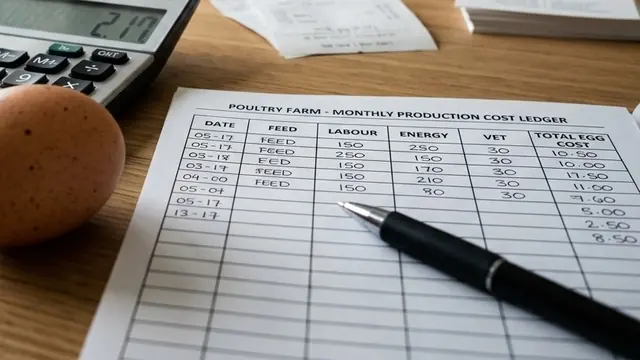
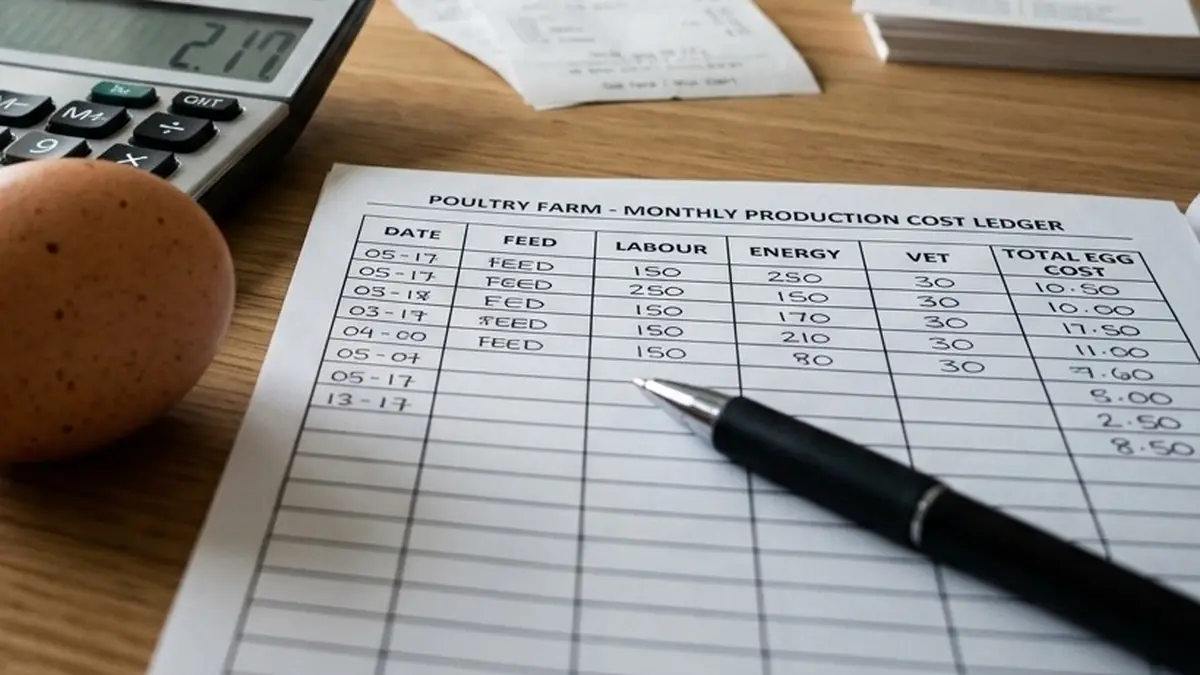
You can't sell below cost: every egg sold takes money with it. How to add up the costs item by item is covered in cost per egg and what it costs to raise a broiler. Here are two corrections that are often forgotten.
- Divide by eggs sold, not eggs laid. Broken, dirty, small eggs and the ones eaten at home bring in no money. 1,000 eggs laid, 950 sold — divide the costs by 950.
- Price meat per kilogram of carcass. A live bird yields roughly 70–75% of its weight as carcass; the figure depends on whether neck and giblets are included. If a kilogram of live weight cost you 1.5 units, a kilogram of carcass at a 72% yield costs about 1.5 ÷ 0.72 ≈ 2.1 units — before slaughter and packaging.
Markup and margin are not the same
Markup is counted on cost, margin on the selling price. Shops and wholesalers usually talk about margin, and mixing them up costs money.
| Markup on cost | Margin in the price |
|---|---|
| 20% | 16.7% |
| 25% | 20% |
| 50% | 33.3% |
| 100% | 50% |
Example: a dozen costs 1 unit, markup is 25%, price is 1.25. The profit of 0.25 is 20% of the price. If a buyer asks for "20% off," you are giving away your whole profit.
Wholesale, shops, retail
Each channel has its own price because your selling costs differ too.
| Channel | What to add to cost | Price |
|---|---|---|
| Wholesaler collects from the farm | Almost nothing | Lowest, but large volume |
| Shop, café | Delivery, packaging, delayed payment | Middle |
| Market, your own customers | Time, stall, transport, unsold stock | Highest |
- Count the trip and the time. Driving to market with 30 dozen costs the same as with 300. If you sell little, the retail price can earn less than wholesale.
- Delayed payment is a cost too. The shop pays in two weeks, but feed must be bought today.
- One price for all regulars. Regular customers talk to each other. Give discounts for volume or for collecting, not "for friends."
Egg size and meat cuts
Graded eggs sell for more, and a large egg costs the hen more feed. In the EU, for example, the grades are: XL — 73 g and over, L — 63–73 g, M — 53–63 g, S — under 53 g. Other countries have their own grades — see storing and grading eggs. Even without official labelling, a "small — medium — large" ladder raises revenue: the small eggs go cheaper instead of pulling down the price of the whole tray.
Meat works the same way. A whole carcass has one price. If you cut it up, each part has its own: breast and legs cost more, backs and frames less. Price the parts so that the whole carcass adds up to more than it would sell for whole — otherwise cutting doesn't pay for the work.
Seasons and holidays
Demand for eggs and meat changes. People buy more before holidays and in the cold months; in summer many have their own hens laying, and demand falls. Don't push the price up and down every week: regular customers don't like it. Better to announce a seasonal price in advance and hold it for the season.
If feed gets dearer and you keep your price, check: feed is usually more than half the cost of an egg. Feed up 20% — the cost per egg rises by about 10% or more. With a 15% markup, that's almost all your profit.
The market is a ceiling, not a guide
Neighbors' and shop prices show what customers are willing to pay. That's the ceiling. Your cost is the floor. Your price sits between them. If the market is below your cost, cutting the price won't help: look for where money is being lost, or for a customer who pays for freshness and taste (customers and sales).
When to review the price
- Every month — compare your cost with your selling price.
- After a feed price rise — straight away, not at the end of the month.
- When laying drops — an ageing flock makes dearer eggs.
- With a new sales channel — it has its own costs.
Prices in your records
In EggPulse the cost per egg is calculated from expenses and collections, and the "Egg profitability" card in Finance puts the selling price, cost and profit per egg side by side — and straight away per 100 and per 1,000. For broilers, "Batch economics" shows the cost per kilogram.
Record each egg sale with the buyer or channel and the price per egg. Then you see what the market, the shop and the wholesaler really bring in, and unpaid sales are gathered on the "Debts" tab.