
The electricity bill comes in half as big again as last time, yet the flock is the same size. You walk round the house: same lamps, same fans. A week later it turns out the exhaust shutters are clogged with dust, the fans are running longer, and a floodlight at the feed shed has been on all night. Hardly anyone tracks electricity and water per bird, so a rise only shows up on the bill. Here's how to break it down by user and where to look for waste.
How much birds drink
The easiest way to judge water in a poultry house is against feed: birds drink roughly twice as much as they eat by weight.
| Bird | Guide | Source |
|---|---|---|
| Laying hen in production (brown hybrid) | 165–236 ml a day on 110–118 g of feed | Hy-Line Brown standards |
| Broiler | 1.6–1.8 L of water per 1 kg of feed at 21 °C | Aviagen |
In hot weather birds drink noticeably more, in cold weather less. So compare intake not with someone else's standard but with your own yesterday and the same week of the last flock. Why a drop in water is an early sign of disease is covered in poultry water consumption.
Besides drinking, water goes on washing the house between flocks, on cooling pads and foggers in hot weather, and on leaks. Leaks are the only item that gives you nothing but wet litter.
Where the electricity goes
In a fan-ventilated house most electricity goes on two things: ventilation and lighting. In a 17-year study at the University of Arkansas research farm (USA), they made up about 87% of all electricity in the broiler houses. Heating there was by gas and didn't show up on the power bill.
The same study compared houses before and after a rebuild. With curtain sidewalls the houses used about 80 kWh per tonne of broiler live weight. After switching to solid walls and tunnel ventilation, about 102 kWh — 27% more: the daylight was gone and the fans ran longer. That isn't a standard for your farm; it shows how strongly use depends on how the house is built.
- Ventilation. The hotter it is and the denser the stocking, the longer the fans run. In summer this is the biggest user.
- Lighting. Layers need light for many hours a day all year round, so for them it's a constant item. More on lighting programs in lighting for laying hens.
- Heating. If you heat with electricity, during brooding it can overtake everything else. How many watts you need is worked out in brooder heating.
- Pumps, feed lines, egg collection, the egg cooler — each uses a little, but every day.
How to work it out yourself
If the house and farm share one meter, you can estimate the poultry house from its equipment: power in kilowatts × hours of running a day.
| Equipment (example) | Power | Hours a day | kWh a day |
|---|---|---|---|
| 20 LED lamps of 10 W | 0.2 kW | 16 | 3.2 |
| 2 exhaust fans of 0.5 kW | 1 kW | 10 | 10 |
| Borehole pump | 0.75 kW | 1 | 0.75 |
| Total | about 14 |
Take the power from the plate on each device. Fan hours change with the season, so do summer and winter separately. Better still, put a separate meter on the house: an estimate from equipment won't show a leak or a device someone forgot to switch off.
Per bird and per egg
A bill in money tells you nothing until you divide it by output. Example: a house of 1,000 layers, 900 eggs a day, 14 kWh and 210 L of water a day.
- Electricity per egg: 14 ÷ 900 ≈ 0.016 kWh, or about 16 kWh per 1,000 eggs.
- Water per bird: 210 L ÷ 1,000 = 210 ml a day — within the hybrid's standard.
- Water per egg: 210 ÷ 900 ≈ 0.23 L.
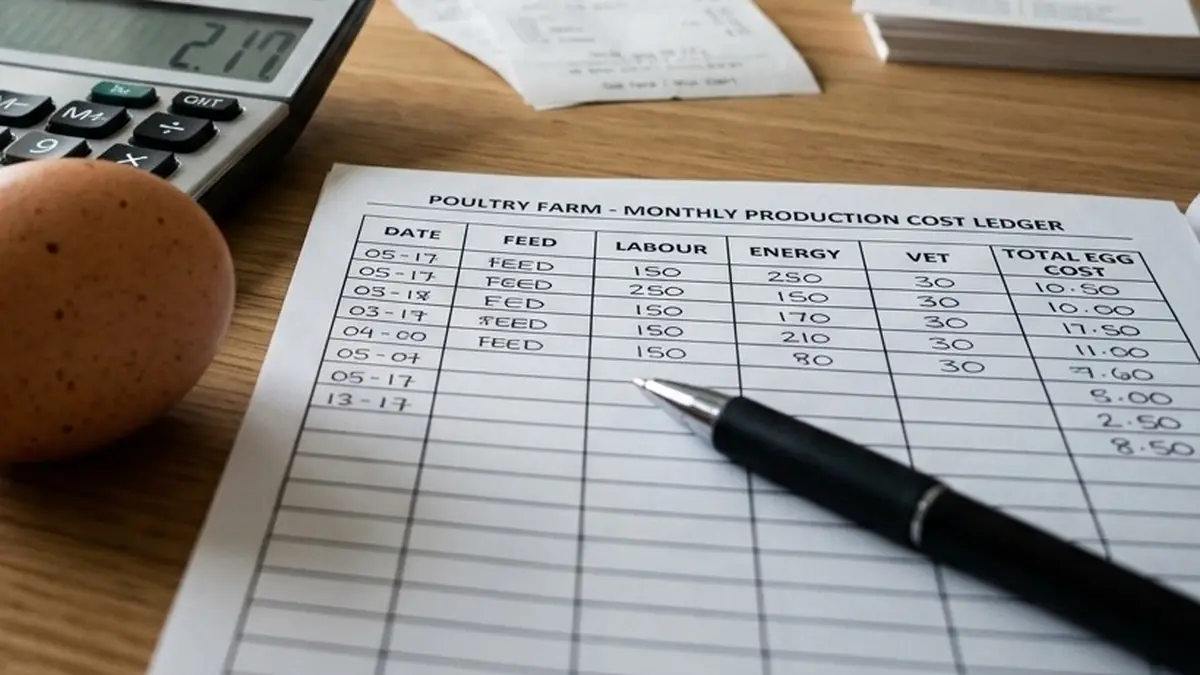
For broilers, work it out per kilogram of live weight for the flock: all the flock's electricity ÷ weight sold. Multiply the kilowatt-hours by your rate and you get a line in your cost of production that people usually forget (hidden costs in egg cost).
Other people's kilowatt standards are almost useless: climate, insulation and ventilation differ everywhere. What helps is your own use per 1,000 eggs or per tonne of weight, month on month and flock on flock. A clear rise with no reason in the weather or bird numbers is a reason to look for a fault.
How to cut electricity use
- LED lamps. According to the US Department of Energy, LEDs use at least 75% less energy than incandescent bulbs. In a house where the lights are on most of the day, you'll see the difference on the first bill.
- Clean shutters and blades. In Auburn University (USA) tests, dirty shutters cut a fan's airflow by 20–27%. The fan runs just as long but moves less air.
- Tight belts. According to Mississippi State University, a fan with a loose belt turns 10–20% slower.
- Timers and thermostats. Lights on a timer, ventilation and heating on a sensor — not "switch on and forget".
- Insulation and sealed gaps. In winter less heat escapes; in summer less sun heats the roof.
If you're thinking about your own power supply, start with how many kilowatt-hours a day you really need: see solar power for a poultry house.
How not to lose water
- Check nipples and drinkers. A leaking nipple shows as a wet patch of litter underneath.
- Set height and pressure. Drinkers too low and pressure too high mean more water on the floor, not in the birds.
- Record every day at the same time. A sharp rise without hot weather is the first reason to look for a leak.
- Start cleaning dry. First remove litter and dust, then soak, then wash: it uses less water than going straight in with a hose.
Electricity and water in your records
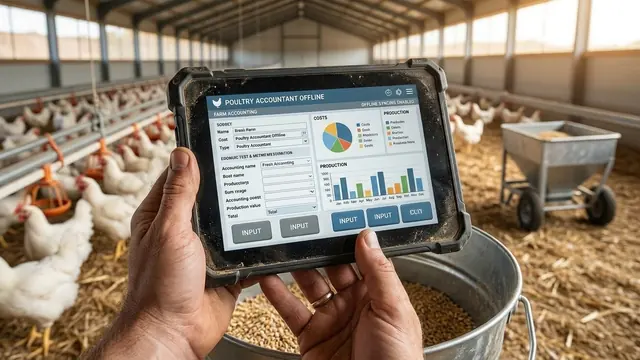
In EggPulse, electricity is recorded per day by house or by meter, with a rate per kWh. The app shows the cost for the period, usage by house and an estimated split by user — lighting, ventilation, heating, feed distribution, water supply — based on the shares you set.
Water is recorded per house per day. The app works out intake per bird per day and the water-to-feed ratio, and, if your water comes from a tank, how long it will last. The water price is also set per farm.