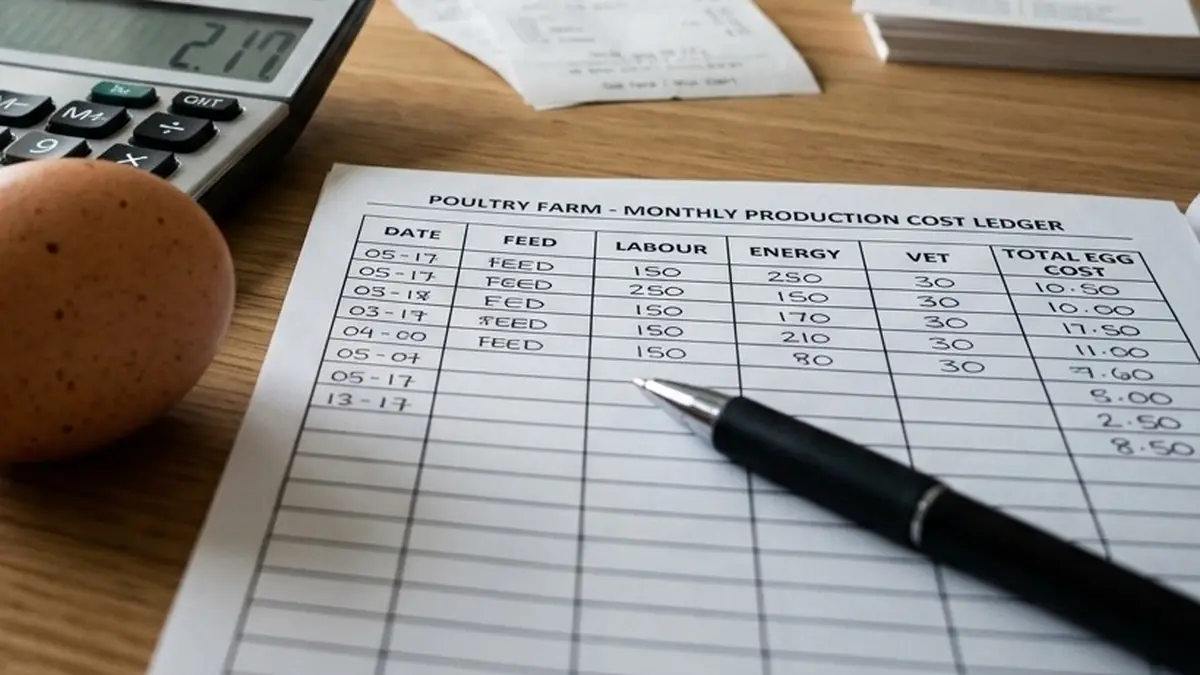

“A chick costs this much, a bag of feed that much — so the carcass costs next to nothing.” After the first batch it turns out almost twice as much money went out: electricity, bedding, dead birds and the feed they ate were forgotten, and three kilograms of live weight only make two kilograms of carcass. Let’s count honestly, using a 100-bird batch.
What goes into it
| Item | What to include |
|---|---|
| Chicks | Day-old chick price and delivery |
| Feed | All the batch’s feed, including what dead birds ate and what was spilled |
| Heat and light | Kilowatt-hours for brooder and lighting, gas if the brooder is gas-fired |
| Bedding | Shavings or straw for the whole batch |
| Vet care | Vaccines, medicines, necropsy |
| Mortality | Chicks and feed that never became a carcass |
| Slaughter | Your own labor or a processor’s fee, bags, chilling |
| Other | Water, disinfection, transport, your time |
Example: a 100-bird batch, slaughtered at 42 days
Prices are in currency units; plug in your own.
| Item | Calculation | Amount |
|---|---|---|
| Chicks | 100 × 0.80 | 80 |
| Feed | 450 kg × 0.40 | 180 |
| Heating | 2 lamps × 6 kWh × 21 days × 0.15 | 38 |
| Bedding | — | 15 |
| Vaccines and vet | — | 10 |
| Other | water, lighting, disinfection | 15 |
| Total | 338 |
With 5% mortality, 95 birds reach slaughter at 3.0 kg — 285 kg of live weight. At a 72% carcass yield, that’s about 205 kg of carcasses.
| Measure | Value |
|---|---|
| Cost per bird | 338 ÷ 95 = 3.56 |
| Cost per kg live weight | 338 ÷ 285 = 1.19 |
| Cost per kg carcass (excluding your slaughter labor) | 338 ÷ 205 = 1.65 |
| Feed share of costs | 180 ÷ 338 = 53% |
Selling below 1.65 per kilogram of carcass is working at a loss, even if it feels like you “made a little.” On large farms feed is 60–70% of costs; on a small farm its share is lower because chicks and heating cost more per bird.
Where money leaks
- First-week mortality. Every dead chick is its price plus the heat spent on it. 10% mortality instead of 3% raises the cost per kilogram of carcass by about 8% (why chicks die).
- Spilled feed. A full feeder loses up to a third of its feed (on feeders).
- An extra week. In weeks 7–8, a kilogram of gain takes 2.2–2.8 kg of feed (when to slaughter).
- Heating without insulation. Lamps in a cold shed are the fastest-growing cost in spring (on insulation).
- An uneven batch. Small carcasses sell for less or don’t sell at all.
If you spend an hour a day on a batch, that’s 42 hours over 6 weeks plus a day for slaughter. Even if you don’t pay yourself a wage, work out what you earn per hour. It helps you decide whether to expand.
Revenue beyond the carcass
Besides carcasses, you can sell giblets, feet, sometimes feathers and manure (on selling manure). Each such line lowers the cost of the main product. Finding buyers is covered in selling eggs and meat.
Cost in the app
In EggPulse costs and income are logged per batch: chicks, feed from the store at purchase price, electricity from the meter, vet care, sales. The cost per kilogram is calculated for you, and two batches can be compared to see exactly what made one more profitable than the other.