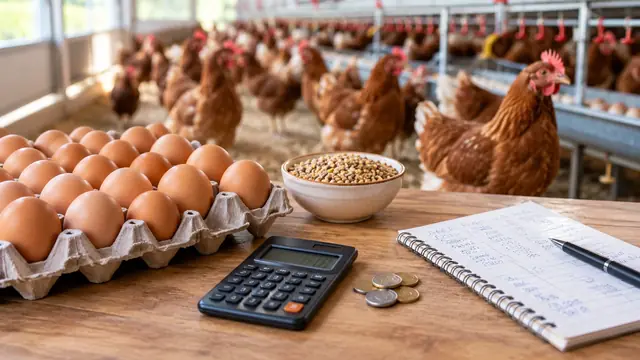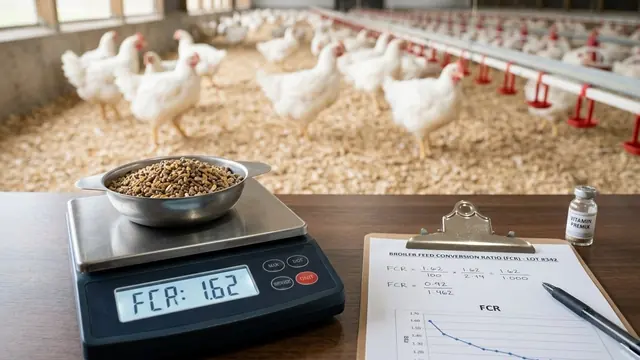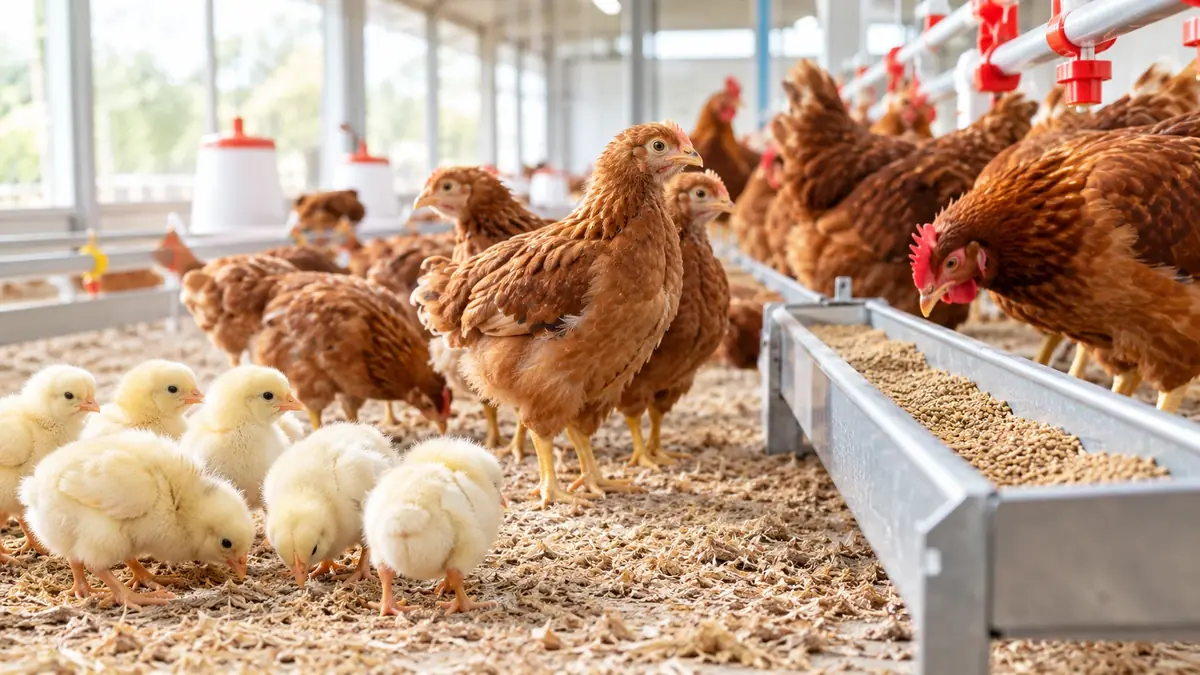

Look under the feeder. If there’s a layer of feed the birds no longer pick up, that’s your money. On a small farm 5 to 15% of feed misses the beak, and feed is two-thirds of the cost of an egg. In other words, you buy every tenth bag for the floor, the rats and the sparrows.
A full feeder is the biggest mistake
A hen searches with her beak, flicks feed aside and drops what she can’t hold. The higher the feed sits at the rim, the more of it flies out. Poultry-keeping guides give these figures for trough feeders:
| Trough filled | Feed wasted, roughly |
|---|---|
| To the brim | 30–45% |
| Two-thirds | 10–12% |
| Half | 3–5% |
| One-third | 1–2% |
Sources differ on the exact numbers but agree on the point: filling less and more often is cheaper than filling to the brim once a day. Fill a trough no more than one-third full.
Height and space
- Feeder lip at the height of the bird’s back. Lower, and birds scratch feed out and foul it. Higher, and young birds can’t reach. Raise the feeder as birds grow — every few days for broilers.
- Space so everyone eats at once. For layers, about 8–10 cm of trough per bird on one side. For broilers on pan feeders, take the number of birds per pan from the feeder manufacturer and the strain guide.
- Crowded means uneven. Strong birds eat their fill, weak ones go short. The flock ends up uneven in weight, and that later shows in both laying and meat yield.
Which feeder is better
| Type | Pros | Cons |
|---|---|---|
| Open trough | Cheap, you can see what’s left | More waste without a lip or spinner |
| Hanging tube feeder | Holds several days, stays clean | Easy to miss that it’s empty or caked |
| With an anti-scratch grill | Birds can’t climb in and scratch | Takes longer to wash |
| Treadle feeder | Feed is out of reach of sparrows and rats | Birds need training, costs more |
A simple trick for any open feeder is an inward-curled lip or a spinner bar over the trough. It often halves the waste.
Mash or pellets
From mash, a hen picks out the coarse particles and leaves or flicks out the fine dust, which is often where the premix and meal are. Pellets and crumbles can’t be sorted and get dropped less. If you feed mash, let the birds clean out the feeder before you add more.
Rats, mice and sparrows
A rat eats 15–30 grams of feed a day and, by most estimates, spoils several times that with urine, droppings and hair. A dozen rats in the shed is a couple of hens’ worth of feed every day, plus salmonella. A flock of sparrows at an open feeder eats less but brings mites and disease.
- mesh on windows and vents;
- feed in closed containers overnight;
- sweep up spills every day;
- bait only in closed stations the birds can’t reach.
How to measure your own waste
Two ways — ideally both.
- Feed per bird. If layers “eat” 140–150 grams when the strain guide says 115–120, the difference is almost all on the floor or with the rodents.
- Stock reconciliation. Bought this month, minus what’s left, minus what the log says was fed — how much vanished? This is covered in detail in the feed inventory article.
200 layers eat about 24 kg a day. 10% waste is 2.4 kg a day, almost 900 kg a year. A new feeder with a lip pays for itself in a couple of months.
Waste in numbers
In EggPulse the day’s feed is divided by the head count, and analytics shows feed per 10 eggs by house. When you change feeders, you can see how much consumption dropped — and whether the change was worth it. Per-bird norms by age are in the feeding norms article.