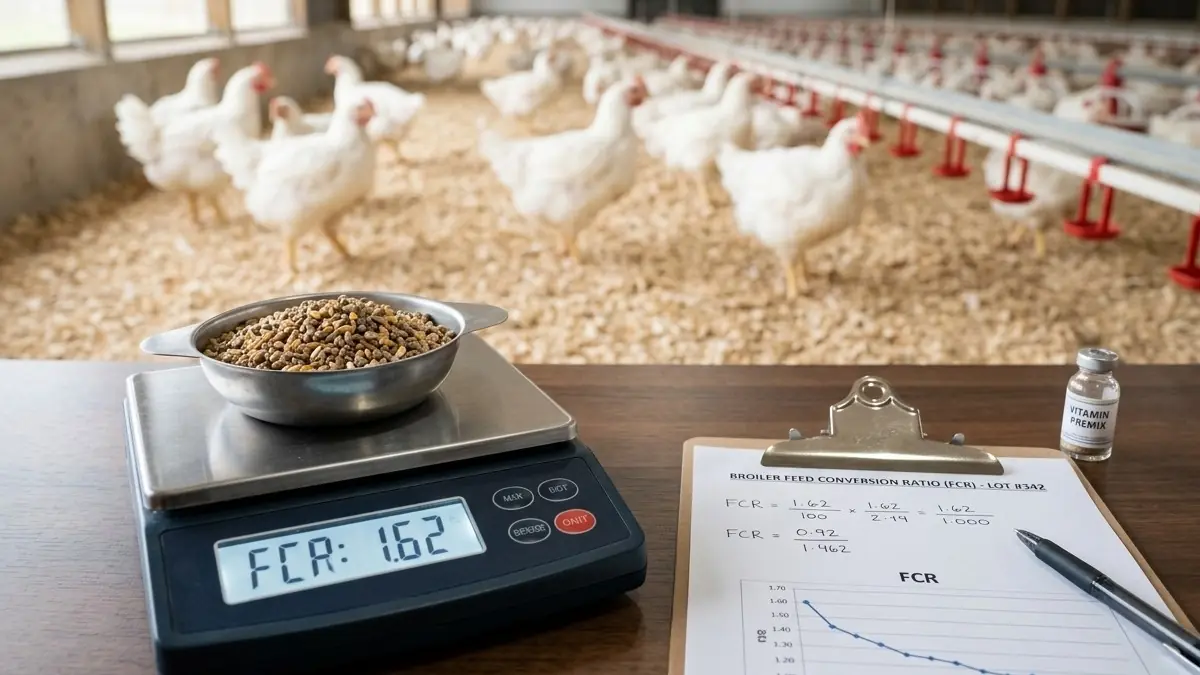

A broiler grows 50–60 times its hatch weight in six weeks. Nothing else on the farm grows that fast. And nothing depends so much on what’s in the feeder right now. A chick in its first days needs one feed, a two-week-old another, and a bird before slaughter a third. Feeding the whole batch one “broiler feed” means overpaying at the end and underfeeding at the start.
Why phases
The younger the broiler, the more protein it needs per gram of feed: it’s building muscle and bone. With age, its protein need falls and its energy need rises. Protein is the most expensive part of feed. Phases keep you from feeding pricey starter to grown birds. And they keep chicks off cheap finisher.
| Phase | Age, roughly | Protein | Feed form |
|---|---|---|---|
| Pre-starter / starter | 0–10 days | 22–23% | Crumbles, mini-pellets |
| Grower | 11–24 days | 20–21% | Pellets |
| Finisher | Day 25 to slaughter | 18–19% | Pellets |
Timing and specs vary by strain. Your strain’s breeder publishes a feeding program — keep it at hand.
Starter: the first ten days decide everything
Seven-day weight is the best predictor of slaughter weight. A chick that under-eats in week one almost never catches up. That’s why starter is the most expensive feed in the program — and the one you can’t skimp on.
- feed within the first hours after placement, on paper or trays so chicks find it;
- dust-free crumbles: fine dust is uneaten feed and clogged nostrils;
- check crops after 24 hours: 95% of chicks should have full, soft crops.
How much feed one broiler eats
A benchmark for a modern strain slaughtered at about 2.5–2.8 kg live weight at 40–42 days:
| Feed | Per bird | Per 500-bird batch |
|---|---|---|
| Starter | 0.25–0.4 kg | 125–200 kg |
| Grower | 1.0–1.5 kg | 500–750 kg |
| Finisher | 2.0–2.8 kg | 1,000–1,400 kg |
| Total | about 4–4.5 kg | about 2–2.3 t |
Many programs set starter by grams per bird rather than by days. Once the birds have eaten that amount, they move to grower. It’s more reliable: slow and fast batches get the same amount of starter.
How to switch
- You can switch straight over if the form is similar. If the pellet size changes, blend for 1–2 days.
- Don’t pour new feed on top of old in the bin: you won’t know when the switch actually happened.
- Note the switch date and what feed was left: that’s how you calculate use per phase later.
Before slaughter
- Medicated feeds and coccidiostats stop before slaughter by the period on the label. That’s why some programs include a separate “withdrawal feed” for the last days.
- Feeders come out 8–12 hours before slaughter, water stays. An empty gut means a clean carcass at processing. And feed eaten in the last hours doesn’t have time to turn into meat.
Most often not in feed price but in an extra week: every day past the optimum, a broiler eats more and gains less. More in the feed conversion article.
Common mistakes
- layer or pullet feed instead of broiler feed — growth half as fast;
- grain mixed without meal and premix: birds grow, but with weak legs and poor conversion (on leg problems);
- starter “until the bag runs out” although the birds have outgrown the phase;
- finisher from day one “because it’s cheaper.”
The batch in the app
In EggPulse a broiler batch is tracked from day one: feed from the log, mortality, weighings. From them the app calculates feed conversion. The feed store shows how many days each feed will last. That way the switch to finisher doesn’t fall apart because the bags didn’t arrive. A step-by-step plan for the whole cycle is in broilers in one season.