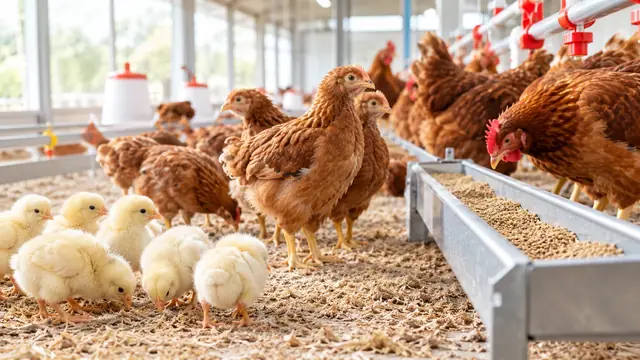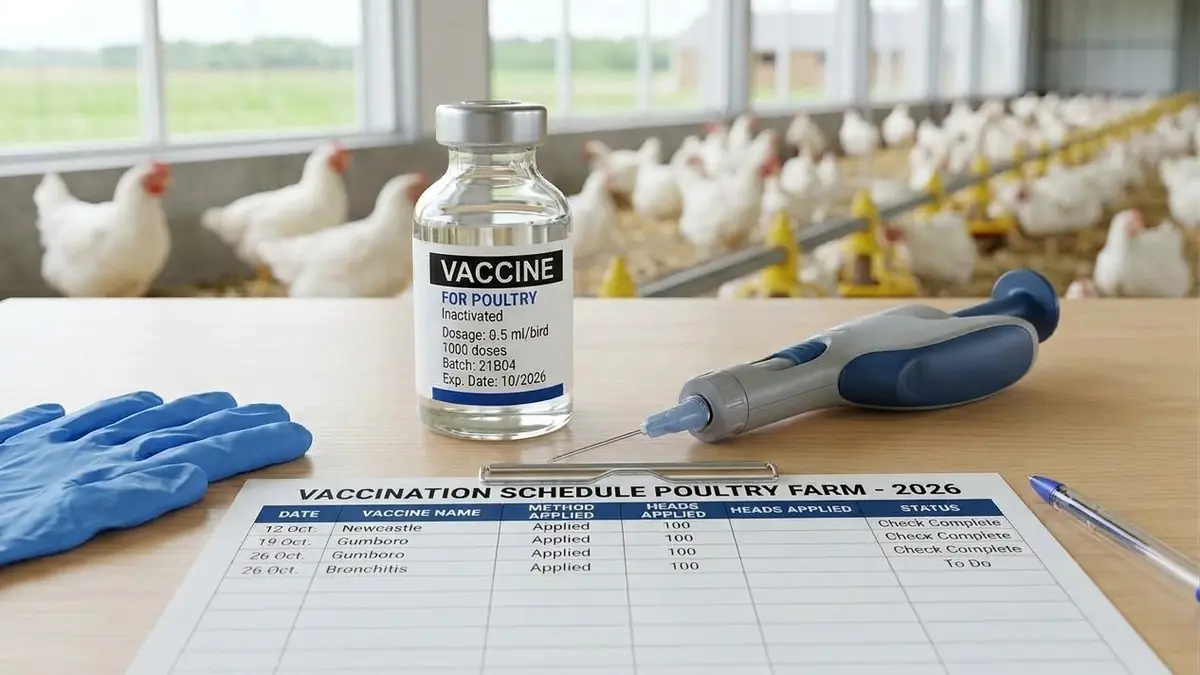

The vaccination schedule is the first thing people ask about when buying chicks — and the first thing they get confused about: the neighbor uses one, the internet another, the vaccine box a third. The reason is simple: there is no single schedule for everyone. It depends on production type (broilers live six weeks, layers a year and a half), on what the hatchery has already done, and on the diseases circulating in your area. Below are the typical programs vets start from, and what a farmer needs to know.
The final schedule is set by a vet who knows the situation in your area. The tables below help you understand what’s being discussed; they don’t replace a vet.
Ask the hatchery first
Many vaccines are given on day one at the hatchery: Marek’s by injection, Newcastle and infectious bronchitis by spray, and sometimes vector vaccines that cover Newcastle or Gumboro with a single lifelong injection. If you don’t know what’s been done, it’s easy to repeat something unnecessary or miss something important. Ask when you order (what else to ask the hatchery).
A typical broiler program
| Age | Disease | How it’s given |
|---|---|---|
| Day 1 (hatchery) | Newcastle + infectious bronchitis (live) | Spray |
| Day 1 (as needed) | Coccidiosis (live vaccine instead of coccidiostats in feed) | Spray or gel |
| Days 14–18 | Gumboro (infectious bursal disease) | In water; the day is chosen by maternal antibody levels |
| Days 18–21 | Newcastle (booster) | In water or by spray |
Commercial broiler strains are often not vaccinated against Marek’s — they don’t live to the age when the disease appears. Colored and slow-growing broilers kept 70–90 days are vaccinated like layers.
A typical program for layers and pullets
| Age | Disease | How it’s given |
|---|---|---|
| Day 1 (hatchery) | Marek’s disease | Injection |
| Day 1 (hatchery) | Newcastle + bronchitis (live) | Spray |
| Days 14–18 and 21–28 | Gumboro, twice | In water |
| 3–4 weeks | Newcastle + bronchitis (repeat) | In water or by spray |
| 6–8 weeks | Newcastle + bronchitis (repeat) | In water or by spray |
| 8–12 weeks | Fowl pox | Wing-web stab |
| 10–14 weeks | Avian encephalomyelitis | In water or wing web |
| 15–18 weeks, before lay | Killed: Newcastle + bronchitis + egg drop syndrome | Intramuscular or subcutaneous |
In areas with mycoplasma, infectious coryza or laryngotracheitis, their own vaccines are added. In several countries vaccinating layers against salmonella is compulsory (on salmonella). The main diseases are covered in Newcastle, Marek’s and Gumboro.
Methods of administration
| Method | Pros | What to watch |
|---|---|---|
| Drinking water | Fast, no catching | Chlorine-free water, birds kept off water 1–2 hours beforehand, vaccine drunk within 1–2 hours |
| Spray | The whole batch at once | Droplet size per the label, birds gathered together, ventilation off for the time |
| Eye drop | The most precise method for live vaccines | The drop must be absorbed; slow for large numbers |
| Wing-web stab | For pox and encephalomyelitis | After 7–10 days check the “take” — a scab at the stab site |
| Injection | Killed vaccines, long immunity | Sterile needles, injection site per the label |
Rules without which vaccination fails
- Cold. Vaccine is transported and stored at 2–8 °C (36–46 °F), never frozen unless the label says so. An opened vial of live vaccine is used within 1–2 hours.
- Chlorine-free water for water vaccination: chlorine and sanitizers kill live vaccine. Stop water treatment 2–3 days before and flush drinkers without chemicals (on water and vaccines).
- Sick birds aren’t vaccinated without a vet’s agreement.
- Record the batch number and expiry date of every vaccine.
- Watch for 3–7 days: mild sneezing after live respiratory vaccines happens; a sharp rise in mortality doesn’t.
Vaccinations in your records
In EggPulse the vaccination schedule is set up for a batch in advance, and the app reminds you of each one. A completed vaccination is saved with date and product, and the batch number fits in the note; a missed one shows up at once, not a week later. How to keep the log is in the vaccination schedule article.