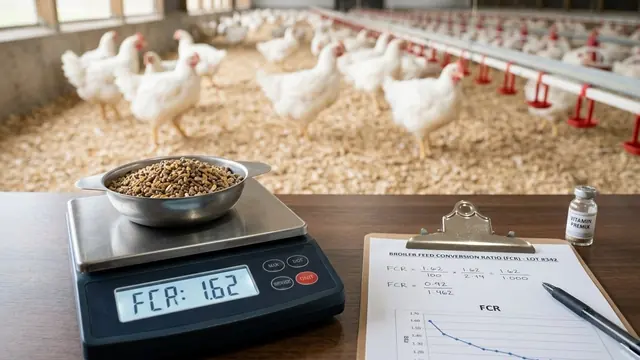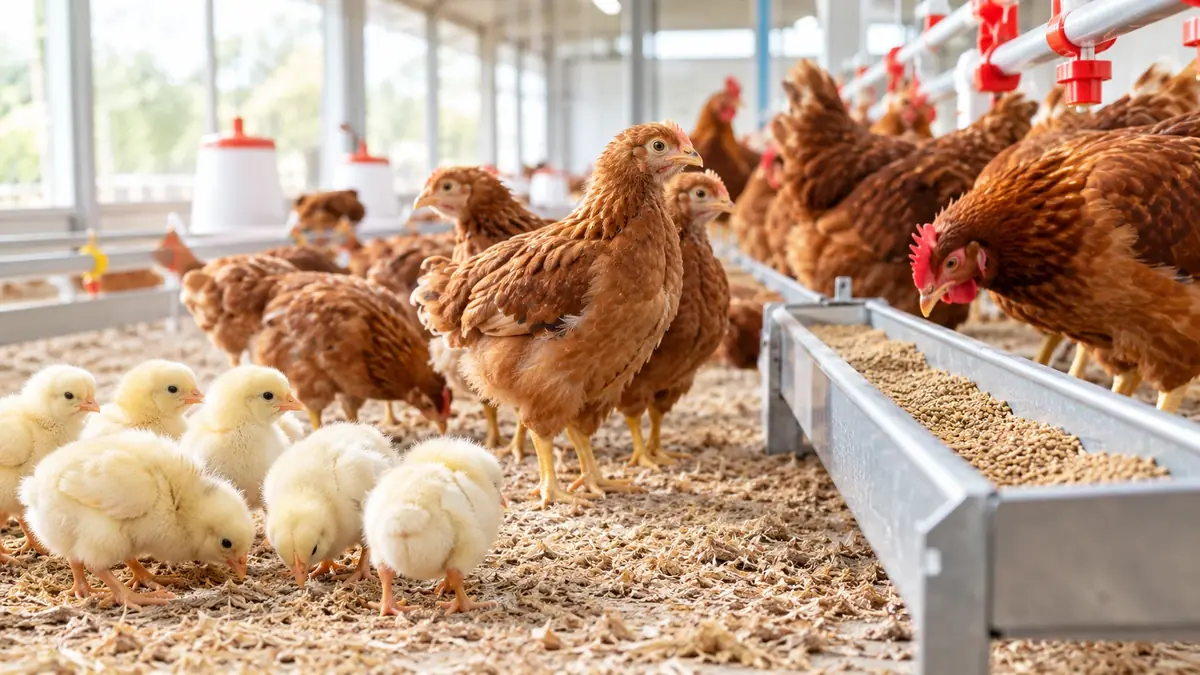

“A boiled egg on day one, then millet, then a wet mash” — that’s how backyard chicks were fed for decades, and they survived. But they grow slower than they could, and a broiler on that diet weighs less at two months than one on starter feed at five weeks. In the first weeks a chick needs a lot of protein in every gram of feed, and the simplest way to provide it is a ready-made starter. Here’s how much they eat and what you can add.
The first day
- Feed and water right away, from the first hour. The sooner a chick eats, the faster the yolk is absorbed and the gut gets going.
- Feed on paper and in trays across the warm zone: chicks find it when they hear their neighbors pecking.
- Crumbles, not dust: starter feed as crumbs or mini-pellets.
- Check after a day: full, soft crops in 95% of chicks (how to check).
There’s no need to feed “8 times a day” if the feeders always have feed in them. But small fresh portions keep the feed clean longer and stop it turning into litter.
Layer chicks: grams by week
| Age | Feed, g per bird per day | Which feed |
|---|---|---|
| Week 1 | 10–13 | Starter, 20–21% protein |
| Week 2 | 13–20 | Starter |
| Week 3 | 20–28 | Starter |
| Week 4 | 28–36 | Starter |
| Week 5 | 36–43 | Starter or grower |
| Week 6 | 43–50 | Grower, 18–19% protein |
| Week 8 | about 60 | Grower |
| Week 10 | about 70 | Developer, 15–16% protein |
This is a guide for brown commercial strains (based on typical Hy-Line Brown and Lohmann Brown tables). White strains eat 10–15% less, and heritage breeds grow slower. Managing pullets until lay is covered in raising pullets.
Broilers: grams by day
| Age, days | Feed per day, g | Eaten since day 0, g |
|---|---|---|
| 1 | 12 | 12 |
| 3 | 20 | 48 |
| 7 | 35 | 165 |
| 14 | 67 | 534 |
| 21 | 105 | 1,153 |
| 28 | 145 | 2,049 |
| 35 | 180 | 3,209 |
| 42 | 207 | 4,585 |
The figures come from Aviagen’s Ross 308 table (2022, as-hatched). Cobb 500 and other strains have their own, similar values. Broilers eat freely: there’s always feed in the feeder except during the dark period and the last hours before slaughter. Moving from starter to grower and finisher is covered in broiler phase feeding.
Eggs, millet, curd and greens
| What people give | Is it OK |
|---|---|
| Chopped boiled egg | Fine for the first 1–2 days as a lure, but not needed with starter feed |
| Millet, cereals | Not as the main feed: little protein and almost no calcium, phosphorus or vitamins |
| Cottage cheese, sour milk | A little from week 2–3, only what’s eaten in 30 minutes — it sours in the warmth |
| Finely chopped greens | From week 2, a little at a time: nettle, dandelion, green onion |
| Fine grit | Needed if you give grain or greens besides feed — without it they don’t get ground |
The rule is the same as for adult hens: extras no more than 10% of the diet, or the chick fills up without getting its protein (what chickens can and can’t eat).
If you have no starter feed, the first two or three weeks are the worst time to experiment: on grain without protein feeds and premix, chicks fall behind and broilers get weak legs. If you do mix your own, formulate it for protein and amino acid norms (how to do it).
How to tell they’re getting enough
- after feeding, almost every chick has a full crop;
- once a week, weigh 20–30 chicks from different spots and compare with the strain target (broiler weight by day);
- the batch grows evenly, with no obvious “runts”;
- feeder space: all of them can eat at once (on feeders).
Feeding in your records
In EggPulse daily feed is logged per batch, and the app shows the norm for the age and strain and compares it with what was actually eaten. If chicks eat below the norm two or three days running, you see it before they fall behind on weight.