
When your own grain is sitting in the barn, buying compound feed seems wasteful. But a hen on wheat alone lays worse and a broiler grows slower, and what you saved on feed goes into eggs and meat you didn’t get. Your own grain can and should be used — once it becomes a balanced ration.
What grain lacks
| Birds need | In grain | What to add |
|---|---|---|
| Energy | Enough | Grain is the base of the ration |
| Protein | 9–13%, too little | Soybean or sunflower meal, oilcake, peas, fish meal |
| Lysine, methionine | Especially short | Meals, synthetic amino acids, premix |
| Calcium | Almost none | Limestone, oyster shell |
| Phosphorus, salt | Too little | Monocalcium phosphate, salt |
| Vitamins, trace minerals | Too little | Premix |
How much protein
| Birds | Protein in feed |
|---|---|
| Layer chicks 0–6 weeks | about 20% |
| Laying hens | 16–17%, calcium 3.5–4% |
| Broilers: starter / grower / finisher | 22–23% / 20–21% / 18–19% |
| Laying quail | 20–22% |
| Ducklings, goslings, poults at start | 20–28% depending on species |
These are averages; check your strain’s guide.
The Pearson square
The simplest way to hit a protein target with two ingredients. Example: a 17% protein layer mix from wheat (12%) and sunflower meal (34%).
- Wheat: 34 − 17 = 17 parts.
- Meal: 17 − 12 = 5 parts.
- 22 parts in all: wheat 17 / 22 ≈ 77%, meal 5 / 22 ≈ 23%.
That covers only the grain and protein part. Calcium, phosphorus, salt and premix are added separately and take up about another 10% of a layer mix. So a real recipe is calculated on all nutrients at once; the square just shows you the order of magnitude.
A premix for your species and age — 0.5–1% of the mix. Without it even a ration perfect on protein will give neither eggs nor growth.
Common mistakes
- mixing “by eye,” different in every bag;
- grinding too coarse: birds pick out the grain and leave the meal;
- moldy grain: mycotoxins hit the liver and laying;
- one mix for both layers and broilers;
- layer-level calcium in pullet feed (on pullets).
Does it pay
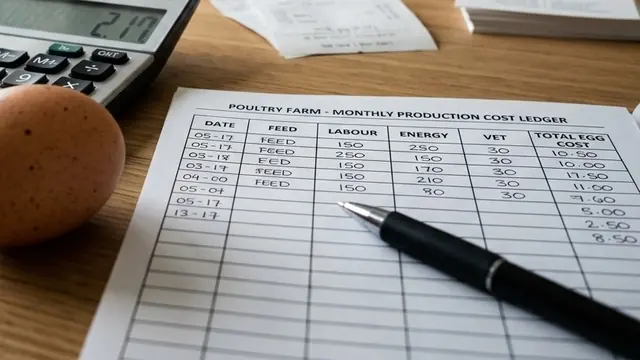
Work out the cost of a kilogram of your mix including meal, premix, limestone and grinding, and compare it with ready-made feed. Compare not the price per kilogram but the cost per egg or per kilogram of gain: a cheap mix that gives fewer eggs costs more. How to calculate feed use is in feed norms.
Formulation in the app
In EggPulse you enter your ingredients with prices and stock on hand, and the app builds a mix to the norm for the species and age and shows the cost per kilogram. When you feed by recipe, each ingredient is deducted from stock. AI hints for formulation are available on paid plans.