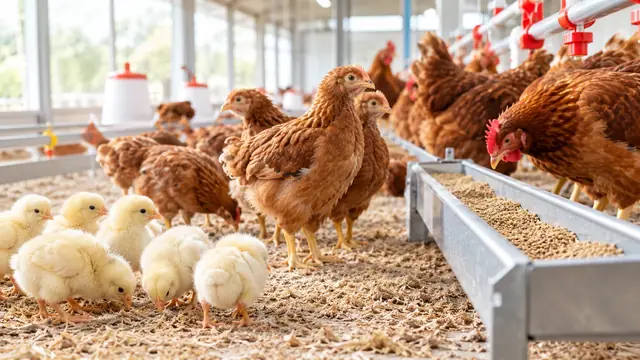

How many eggs a hen will lay is largely settled before she lays her first one. A pullet that is underweight at 18 weeks, or was reared on the wrong lighting, will lay small eggs all cycle and run out of steam sooner. So weeks 0–18 aren’t “waiting for eggs” — they’re the most important part of working with a layer.
Stages
| Age | What is being built | What matters |
|---|---|---|
| 0–6 weeks | Organs, immunity | Heat, a good start, vaccinations |
| 6–12 weeks | Skeleton | Weight on target; the frame is nearly complete by week 12 |
| 12–16 weeks | Muscle, reserves for lay | Don’t overfeed, keep uniformity |
| 16–18 weeks | Sexual maturity | Pre-lay feed, move to the laying house, light |
The first two weeks are covered separately in raising chicks.
Weight and uniformity
Weigh 30–50 pullets once a week from week 4, at the same time. Guidelines for brown egg-laying strains:
| Age | Body weight, g |
|---|---|
| 4 weeks | 260–300 |
| 8 weeks | 620–680 |
| 12 weeks | 1,000–1,100 |
| 16 weeks | 1,350–1,450 |
| 18 weeks | 1,500–1,600 |
White strains are lighter. Exact figures are in your strain’s guide. The average isn’t all that matters — uniformity does too: it’s good when 80% of pullets are within ±10% of the average. A mixed flock comes into lay unevenly and never hits a proper peak. How to calculate uniformity is covered in weighing broilers — the rule is the same for pullets.
Light
From 3–4 weeks the day is cut to 8–10 hours and held there, with no increase, until 16–17 weeks. Light is added only once pullets have reached the target weight, by 30–60 minutes a week. Adding light earlier triggers lay in an undersized bird. Details in lighting for laying hens.
Phase feeding
- Starter (0–6 weeks): about 20% protein.
- Grower (6–12 weeks): 17–18%.
- Developer (12–16 weeks): 15–16%, less energy, more fiber — so crop and gizzard get used to a large volume of feed.
- Pre-lay (16–18 weeks): more calcium than grower, less than layer feed: about 2–2.5%.
Don’t give layer feed too early: excess calcium before lay harms the kidneys.
Vaccinations
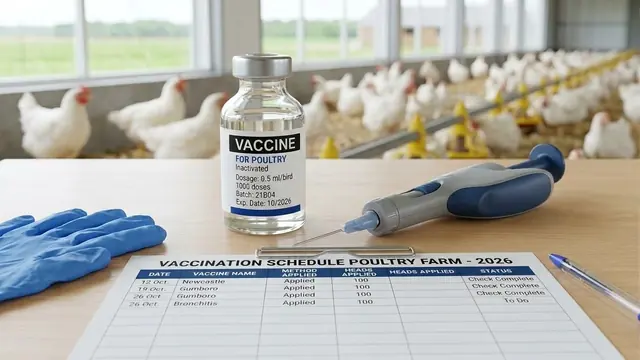
By the start of lay, pullets should have completed the whole program: usually Marek’s at the hatchery, Newcastle disease, infectious bronchitis, Gumboro, and, depending on the situation, fowl pox, avian encephalomyelitis and others. The vet draws up the schedule; we covered the main diseases in Newcastle, Marek’s and Gumboro.
Moving to the laying house
- Move at 16–17 weeks, before the first egg: the stress of moving at the start of lay sets it back for a long time.
- From 4–6 weeks, train them to perches if the laying house will have them.
- Open nest boxes right away so pullets don’t get used to laying on the floor.
A flock from day-old to lay
In EggPulse a pullet flock is tracked from hatch date: weekly weights, feed, mortality and vaccinations. Falling behind schedule shows at once, and when the flock moves to the laying house its history moves with it.