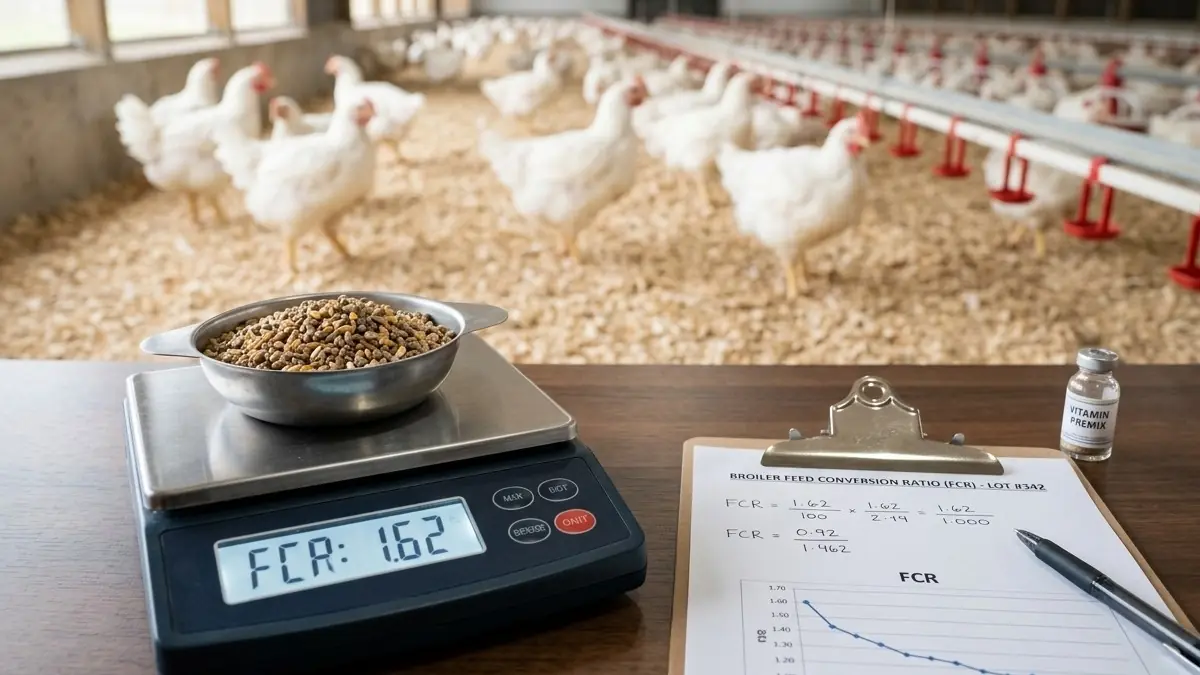

Broilers grow so fast that you can’t see them falling behind: they get bigger every day. Scales are the only way to know whether the flock is on schedule. Without them you can’t work out feed conversion or the slaughter date.
When to weigh
- Once a week at minimum. In the first two weeks it helps to weigh more often, for example on day 3 and day 7.
- Same weekday, same hour. Morning before feeding is best: a full crop adds tens of grams.
- Always under the same conditions, on the same scales.
How many birds
Weigh a sample: 30–50 birds in a small flock, 1–2% in a large one, but no fewer than 50–100. The key is to take birds from different places: by the walls, in the center, at feeders and drinkers. The easy-to-catch birds are usually the biggest or the weakest, and an average based on them lies.
Use a hurdle to pen off a section in several places in the house and weigh every bird caught inside. That makes the sample random.
What to compare against
Every strain has a table of target weights by day. Guidelines for modern broiler strains, as-hatched average:
| Age | Live weight, g |
|---|---|
| 7 days | 180–210 |
| 14 days | 480–550 |
| 21 days | 950–1,050 |
| 28 days | 1,550–1,700 |
| 35 days | 2,200–2,400 |
| 42 days | 2,800–3,000 |
These are targets for commercial conditions. On a small farm weights are usually 10–15% lower, and that’s fine. What matters is that the gap doesn’t widen week by week.
Why day 7 matters so much
Day-7 weight should be roughly 4–5 times the day-old weight. If it’s lower, the chicks started badly: they were cold or didn’t find feed or water. The first week is almost impossible to make up later, and that gap will carry through the whole flock. How to set up the start — see the first two weeks.
Uniformity
The average can look fine while the flock is mixed: some birds big, some behind. That shows in uniformity — the share of birds within 10% of the average weight.
| Uniformity | Rating |
|---|---|
| Above 80% | Good |
| 70–80% | Acceptable; check feeders and drinkers |
| Below 70% | Poor: crowding, too little feeder space, disease |
If weight is behind
- Does every bird have room at feeders and drinkers?
- Is it too cold or too hot (house climate)?
- Is it the right feed for the age, and is it a new batch of feed?
- How much is the flock drinking? A drop in water use often comes before slower growth (on water use).
Weight, target and FCR side by side
In EggPulse weighings are logged per flock, and the average weight appears on a chart next to last week’s. Together with feed use the app calculates feed conversion, so falling behind shows up both in weight and in money.