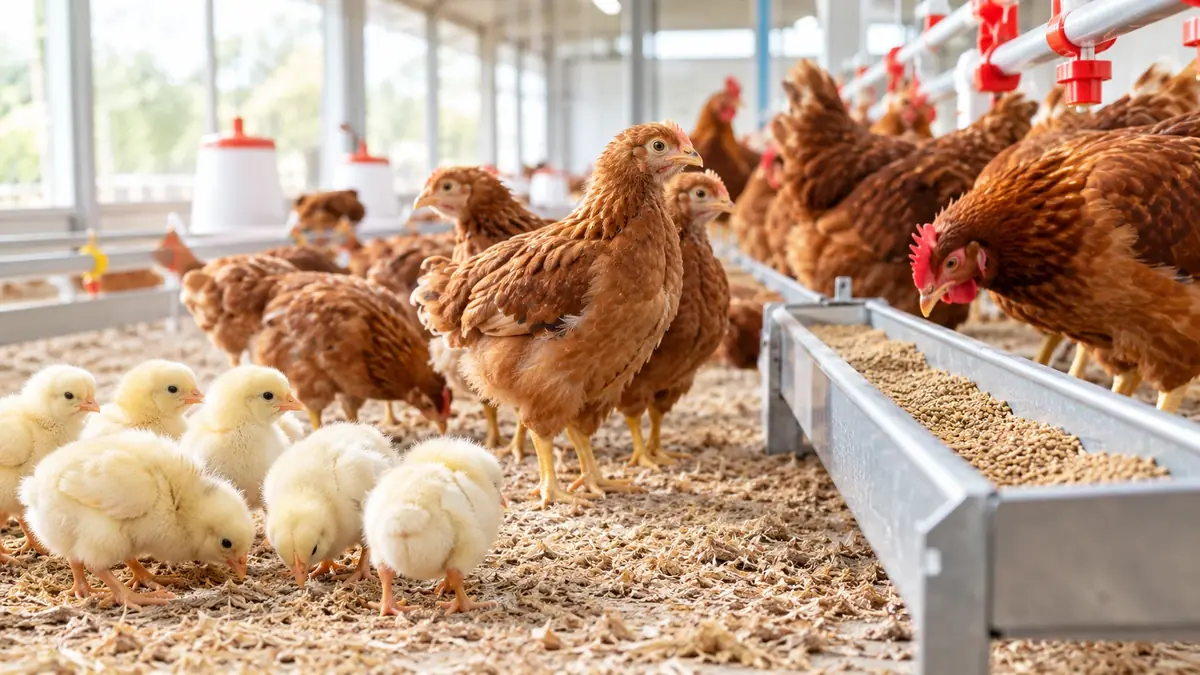

Cage sellers promise three times as many birds in the same space. That’s true, but cages have a price, and not only in money. For a small farm the choice depends on how many birds, what building, and how much you’re ready to invest at the start.
Comparison
| Floor (deep litter) | Cages | |
|---|---|---|
| Investment | Low: litter, feeders, drinkers | High: cages, watering, manure removal |
| Birds per m² of building | 12–16 | 2–3 times more thanks to tiers |
| Coccidiosis | Higher risk: contact with droppings | Lower risk |
| Legs and breast | Better: birds walk | More breast blisters and leg problems |
| Labor | Litter change between flocks | Daily manure removal, equipment maintenance |
| Rules | Allowed everywhere | Restricted for broilers in some countries |
When to choose the floor
- Flocks of up to a few thousand birds.
- You have a building with enough floor space.
- A limited budget at the start.
- You sell “farm” chicken: buyers value birds not raised in cages.
On the floor, dry litter and ventilation matter most. How to choose litter — see our bedding article.
When cages make sense
- Little floor space but many birds needed.
- Year-round, continuous production.
- Money for good equipment and the skill to maintain it.
Cheap cages without proper watering and manure removal usually cost more than the floor: birds grow worse and take more time.
A compromise
Many small farms keep chicks in brooder cages for the first 2–3 weeks, where warmth and hygiene are easier, then move them to the floor. It cuts early losses without big investment.
How to calculate
Compare per bird: equipment investment divided by the number of flocks over its service life, plus feed, litter, electricity and labor. Account for revenue too: floor-reared carcasses are often better and so sell for more. The calculation steps are in your first broiler season, and cost in farm profitability.
Compare on your own numbers
If you try both systems, set up two houses in EggPulse and track the flocks separately. Weight, feed conversion, mortality and cost per bird are compared in the same terms, and your own data settles the “which is better” argument.