
“How much should a broiler weigh at a month?” is the most common question from people raising their first batch. The answer depends on the strain: every breeding company has its own table, and the difference at slaughter can reach 300 grams. Below are the targets for the three most common strains, from the breeders’ official tables — the same ones the app uses.
Weight by week
| Age, days | Ross 308, g | Cobb 500, g | Hubbard Efficiency Plus, g |
|---|---|---|---|
| 0 | 44 | 42 | 43 |
| 7 | 213 | 202 | 216 |
| 14 | 533 | 570 | 541 |
| 21 | 1,012 | 1,116 | 1,035 |
| 28 | 1,616 | 1,783 | 1,647 |
| 35 | 2,296 | 2,521 | 2,330 |
| 42 | 2,998 | 3,278 | 3,028 |
| 49 | 3,681 | 4,001 | 3,704 |
| 56 | 4,318 | 4,641 | 4,324 |
Sources: Aviagen Ross 308 Broiler Performance Objectives 2022, Cobb-Vantress Cobb 500 Broiler Performance & Nutrition Supplement 2022, Hubbard Efficiency Plus Broiler Performance Objectives 2023. All figures are for a mixed-sex (as-hatched) batch grown under good commercial conditions. Males weigh more, females less.
How much feed it takes
| Age, days | Ross 308: total feed, kg | Conversion | Cobb 500: total feed, kg | Conversion |
|---|---|---|---|---|
| 21 | 1.15 | 1.14 | 1.32 | 1.18 |
| 28 | 2.05 | 1.27 | 2.36 | 1.32 |
| 35 | 3.21 | 1.40 | 3.64 | 1.44 |
| 42 | 4.59 | 1.53 | 5.10 | 1.56 |
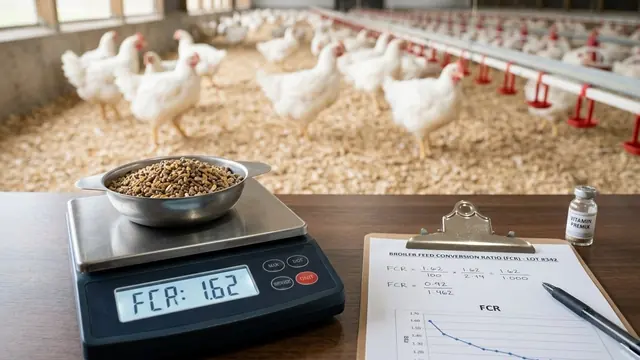
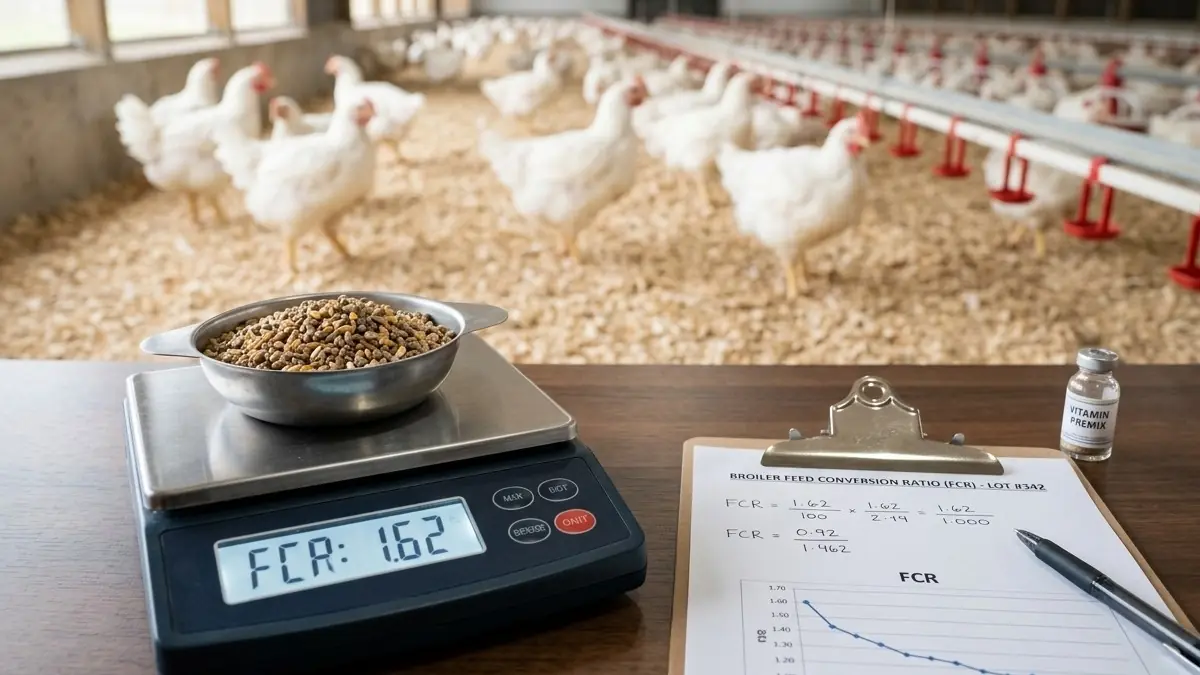
Conversion here is feed eaten divided by live weight. On a backyard or small farm it is almost always 10–20% worse than the table: feed gets spilled and temperature swings. How to get closer to the figures is covered in the feed conversion article.
Colored and local broilers
Slow-growing strains and local crosses grow half as fast: about 830 g at 28 days, 1.5 kg at 42 days and 2.1 kg at 56 days. Comparing them with the Ross table makes no sense — by that measure such a batch is always “behind.” More in colored broilers.
How to weigh
- once a week, on the same day and hour, before the morning feed;
- 20–30 birds in a small batch, 50–100 in a large one — from different parts of the house, not just those nearest the door;
- look not only at the average but at the spread: in an even batch, 80% of birds fall within ±10% of the average.
How to do it without stressing the birds is covered in weighing broilers.
If the batch is behind
- Compare the day-7 weight. Falling behind in week one is almost never made up — so the problem was in the brooder, receiving or the chicks (on the first week).
- Check the feed: the right feed for the age, enough feeder space, feeders not running empty (on phase feeding).
- Water: a broiler drinks almost twice what it eats; with too few drinkers it eats too little.
- Temperature and air: overheating and ammonia cut appetite fastest.
- Health: coccidiosis, leg problems, respiratory infections.
Weight in your records
In EggPulse a batch is set up with its strain, and the app plots the weight and feed targets by day for that strain — and a separate, slower curve for colored broilers. Enter a weighing and you immediately see how many percent the batch is ahead or behind, and conversion is calculated for you.