
You’ve decided to build a second house. Your money covers half; the rest is a loan or a support program. At the bank they don’t ask about the breed of hen but about something else: “How much do you earn? How can you prove it? What happens if the egg price falls?” Those who come with numbers get an answer faster and on better terms. Let’s see what to prepare in advance.
The lender’s five questions
Banks around the world assess a borrower with the same scheme — the “five Cs” of credit. Support programs look at much the same, though each has its own rules.
| Question | What it means | How the farmer answers |
|---|---|---|
| Who you are | Reputation, experience, credit history | How many years you’ve kept poultry, how you paid past debts |
| Can you pay | Is income enough for the payments | Income and costs by month, a projection forward |
| How much is yours | Your own money and assets in the business | What you put in yourself, the farm’s debts and assets |
| What secures it | Collateral in case of default | Land, buildings, machinery |
| Conditions | Loan purpose, market, prices | What the money is for, who you sell to, how prices move |
Documents usually requested
- A farm balance sheet. What you own (houses, equipment, birds, feed stock, cash) and what you owe. It’s the first thing a lender looks at.
- Income and costs for past years. Often two to three years. If the farm is younger — for its whole life.
- Production history. Bird numbers, laying rate or livability, how much was sold.
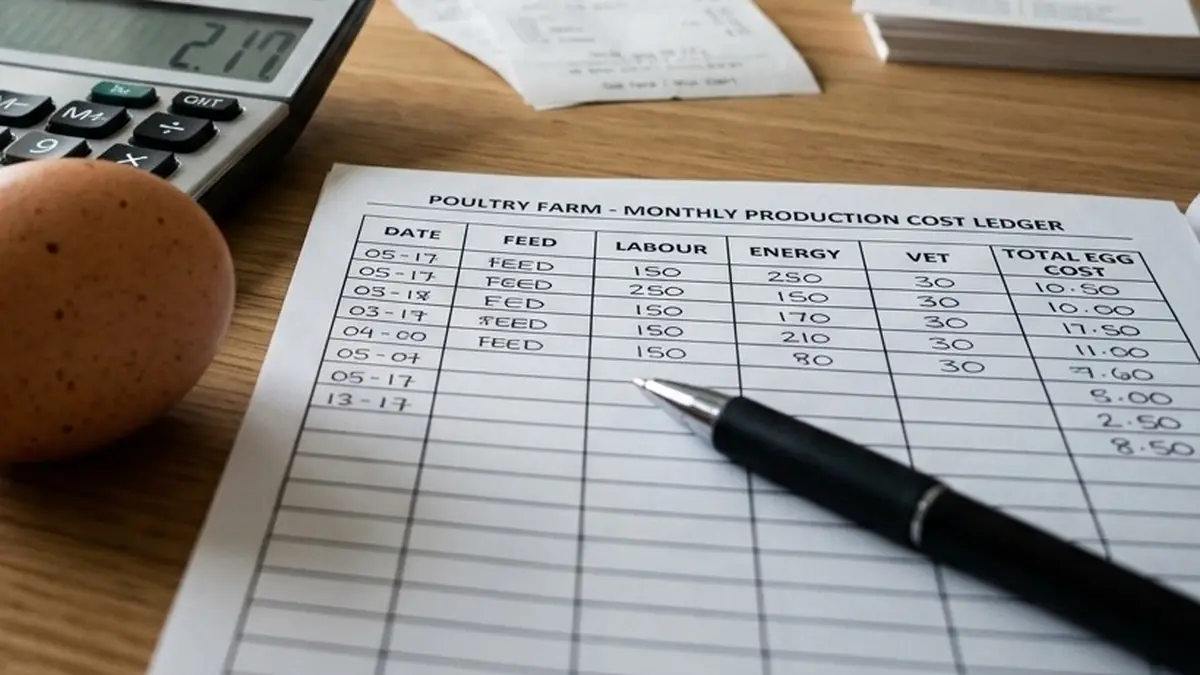
- A cash flow projection for the loan term: how much money comes in and goes out each month, including bank payments.
- A business plan for the investment. What the money is for, how much revenue it adds, when it pays back (how to work it out).
Each bank and program has its own exact list — ask for it in advance. An incomplete package is a common reason an application sits for weeks.
Cash flow matters more than profit
A year’s profit can be good while there’s no cash for the payment in a given month. A new flock of pullets only eats for months before it starts laying. Broiler income arrives every six to eight weeks, while the bank wants a payment every month. So the projection shows, month by month:
- In: sales of eggs and meat, spent hens, manure.
- Out: feed, pullets or chicks, vet care, power and water, wages.
- Payments: on the new loan and existing ones.
- The balance at month-end — it shouldn’t go negative.
Start the projection from your actual records of past years, not from “how it should be.” The lender will check your forecast against your history: if the plan shows a laying rate higher than you’ve ever achieved, it shows at once.
A safety margin
Banks look at how many times the farm’s free cash for the year exceeds its yearly debt payments. Many lenders want to see at least 1.25: for every unit of payment, 1.25 units free. Requirements vary, but the idea is the same — you need a cushion for a bad year.
Rework the cash flow if feed costs 20% more, if the selling price falls 10% and if livability or laying is 5 points worse. If even one case leaves a payment uncovered, borrow less or stretch the term. Show these cases to the bank yourself — it counts in your favor.
If it’s a support program
Program terms vary widely between countries and years, so there are no general rules. They usually ask the same as a bank, plus:
- A fit with the program’s goal. For example, new capacity only, young farmers only or certain areas only.
- Your own share. Part of the investment often has to be paid by you.
- A report after the money arrives. How the funds were spent and whether the promised results were reached: bird numbers, output, jobs.
That last point means you’ll need records after you get the money too — sometimes for several years.
Records that convince
A lender trusts numbers that have a history. A notebook of figures “from memory” convinces less than two years of monthly records that show seasonality, mortality and sale prices. Especially valued:
- Daily logs of egg collection, feed and mortality — they show real productivity.
- Results of each batch or flock: livability, conversion, cost (on profitability).
- What buyers owe you and what you owe suppliers — the lender wants to know the farm’s money isn’t stuck in other people’s pockets.
How to turn these records into reports for the bank and the vet — see farm records for the bank, vet and buyers.
Loans and grants in your records
In EggPulse the egg, feed, mortality and weighing logs are kept daily, and Finance collects income and costs. Reports include Profit & loss, Cash flow and Profit by house; Debts shows what others owe you and what you owe; Budgets help keep spending on plan once the money arrives.
For the bank, all of this can be exported to Excel or PDF for a month, quarter or year: logs, flock summaries and finance. So you come to the loan conversation not with promises but with the farm’s history.