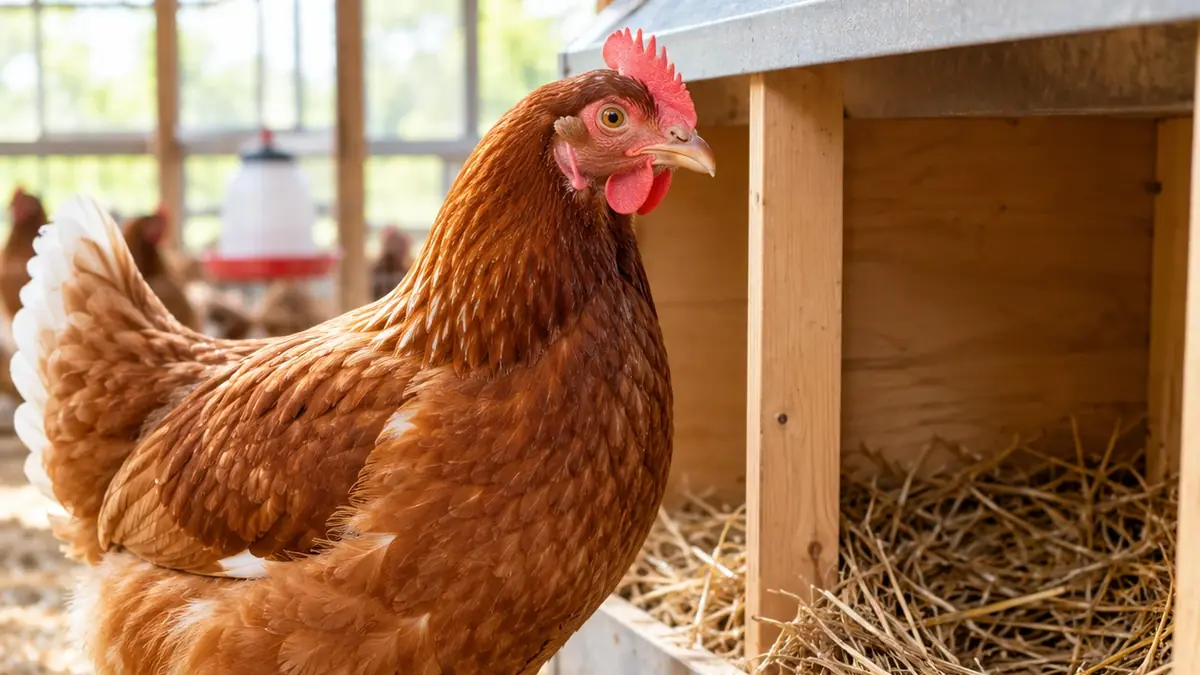

A hen hasn’t left the nest for three days; she puffs up and growls when you reach for her. That isn’t illness but broodiness — a free incubator that holds temperature and humidity and turns the eggs itself. For it to work, the hen needs a little help: the right spot, the right eggs, and three weeks of not being disturbed.
Is the hen ready
- she sits in the nest day and night, leaving it only briefly;
- she puffs up, growls and pecks your hand;
- she plucks the feathers on her breast — bare skin warms eggs better;
- she stops laying.
Test her for 2–3 days on dummy eggs or a few eggs you don’t need. If she sits tight the whole time, she can be trusted with real ones. Brahmas, Cochins, Orpingtons, Silkies and many local hens go broody readily; in commercial hybrids the instinct has been almost bred out.
The nest
- Away from the flock: in a box or crate in a quiet, dim corner. Other hens climb in to lay and break eggs.
- A nest of 40 × 40 cm (16 × 16 in), shallow, with hay or straw; a layer of soil or turf at the bottom holds moisture.
- Feed, water and a box of ash or sand for dust bathing nearby, but not in the nest itself.
- Move her in the evening, in the dark, together with the dummy eggs: in daylight hens often abandon a new spot.
- Check for mites on the hen and in the nest: in three weeks mites can bleed a broody hen dry (on red mite).
How many eggs and which
| What | How to do it right |
|---|---|
| Number | As many as she covers in a single layer: 10–15 chicken eggs for a medium hen, up to 18 for a large one |
| Freshness | No older than 7 days, stored at 12–16 °C (54–61 °F) pointed end down |
| Selection | Clean, normal shape, no cracks or bumps; don’t wash them |
| Origin | From a flock with a rooster and on proper feed (on feeding the breeder flock) |
| Marking | Mark them in pencil: new eggs laid by other hens must be removed |
Set all the eggs at once so the chicks hatch on the same day. A hen can also hatch duck eggs (28 days) and 3–5 goose eggs (about 30 days), but large eggs are harder for her to turn (periods by species).
The 21 days
- The broody leaves 1–2 times a day for 10–20 minutes to eat, drink and dust-bathe. If she doesn’t, gently lift her off once a day: without food and water she weakens.
- Feed grain and complete feed: droppings on grain are firmer and soil the nest less.
- Soiled eggs are wiped carefully with a dry cloth; broken ones are removed at once with the spoiled bedding.
- Candle on day 7 to remove infertile eggs (they’re clear right through) and on day 18 to remove dead ones. After day 18 the broody isn’t disturbed again (how to candle eggs).
The hatch takes up to a day. A chick whose shell is broken too early often bleeds from the membrane vessels. If whole eggs remain on day 22–23, check them in warm water or on the candler before throwing them out.
After the hatch
- for the first day the chicks stay under the hen and need nothing;
- after that — starter crumbles and a shallow drinker a chick can’t drown in (on feeding chicks);
- keep the hen and chicks apart for 2–3 weeks: other hens may peck the babies;
- chicks stay with their mother 4–6 weeks, after which she starts chasing them off herself.
If you don’t want a broody
A hen sitting without eggs doesn’t lay and loses weight. Put her for 2–3 days in a wire-floored crate in the light, with feed and water: cool air from below breaks the instinct. Just chasing her off the nest rarely works.
The broody in your records
In EggPulse a clutch under a hen can be set up as an incubation batch, with the date, number and species of eggs. The app reminds you of candling and hatch days, and the result is saved so you can compare the hen with the incubator.