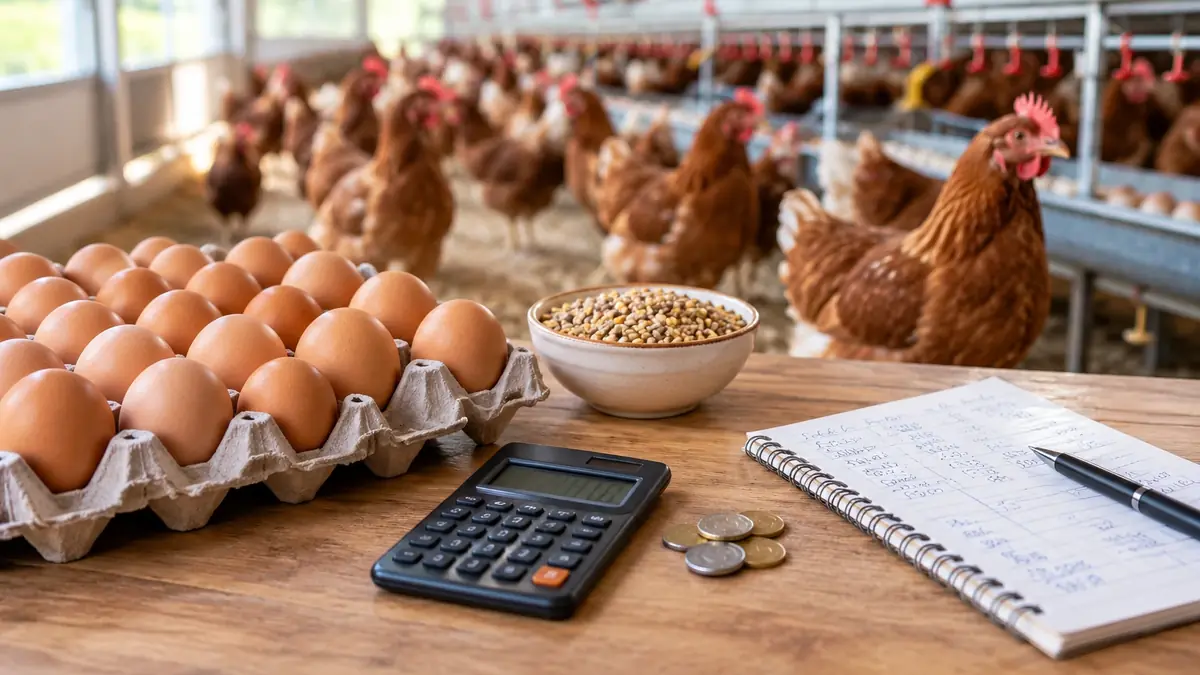

In Thailand, Vietnam, Indonesia or Nigeria, corn and soy are often imported and expensive, while local ingredients are piled up nearby: cassava roots, bran from the rice mill, cake from the oil press. They can make a good, cheap ration. But each has its own trap, and if you don't know about it, the saving turns into dead birds or empty nests.
Cassava (manioc, tapioca)
Dried cassava root is almost pure starch. In energy it's close to corn, but it carries only 2–3% protein against corn's 8–9%. Everything missing must come from meal and amino acids.
Cassava contains compounds (mainly linamarin) that release hydrogen cyanide when the cells are damaged. "Bitter" varieties have a lot; "sweet" ones less. Never feed birds raw roots or fresh leaves.
How to make cassava safe:
- Chip it thin and sun-dry for 2–3 days. Most of the toxic compounds disappear.
- Soak or ferment before drying — even better.
- Don't skimp on methionine. Birds detoxify leftover cyanide using sulfur from methionine. A cassava ration needs a little more methionine than the norm.
How much: well-dried cassava up to 20–30% of the ration for broilers and layers, sometimes more if protein and methionine are covered. Cassava is dusty and gives pale yolks, so it's often pelleted and pigments are added separately (egg yolk color).
Cassava leaves are a protein feed: 20–25% protein when dried. But they hold more cyanide too, so they're dried and fed at up to 5–10% (leaf meal).
Rice bran
Bran from the rice mill is the grain's outer layers and germ: 12–14% protein, 12–20% fat, rich in B vitamins. Good bran is nearly as high in energy as grain.
| Type | How it differs | How much |
|---|---|---|
| Fresh full-fat | High energy, but goes rancid | 10–20%, fresh only |
| Stabilized (heat-treated) | Fat keeps for months | up to 20–25% |
| De-oiled | Less energy, more fiber | 10–15% |
| Mixed with hulls | Lots of fiber and silica, little value | as little as possible |
The big problem is rancidity. Bran contains an enzyme that starts breaking down the fat as soon as the rice is milled. After a few warm days the bran tastes bitter, birds eat it less, and vitamins are destroyed. Buy it fresh, keep it cool and use it within a week — or buy heat-stabilized bran.
Rice bran is very high in phytate, so its phosphorus is barely available without phytase (phytase).
Palm kernel cake
Palm kernel cake is a cheap by-product of oil palm: 14–18% protein, 15–20% fiber and a lot of mannans, which birds digest poorly. It also contains sharp fragments of nut shell.
- Broilers up to 5–10%, layers up to 10–15%, ducks more.
- With a mannanase enzyme, a little more.
- Buy it without much shell: shell scratches the gut and takes up room in the ration.
Similar in character are copra cake (from coconut) and cottonseed cake. On cottonseed meal and its danger to yolks, see replacing soy.
Building the ration
A typical tropical layer mix might look like this: cassava in place of part of the corn, rice bran at 10–15%, a little palm kernel cake, fish meal or soybean meal for protein, plus methionine, lysine, shell and premix. The key is to balance it all together: each ingredient is "fine" on its own, but the total can still fall short on energy or methionine. How to balance a ration is covered in rations from your own grain.
Storage in heat and humidity
Feed spoils fastest in the tropics. Cassava and bran absorb moisture, go moldy and build up aflatoxins. Store on pallets in a dry, ventilated place, and don't stock more than 2–3 weeks' worth (mold and mycotoxins, mycotoxin binders).
Local ingredients in your records
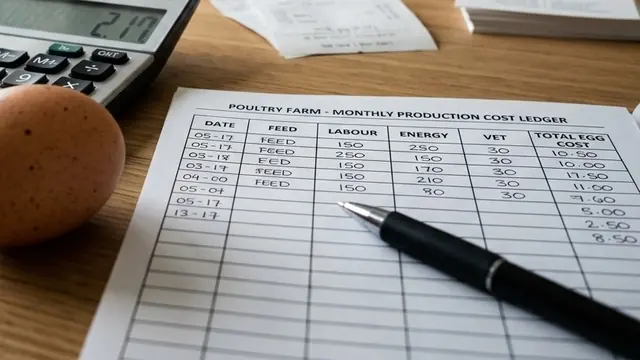
In EggPulse, cassava, bran and cake go into the store as separate ingredients with price and protein, and you can attach a lab analysis to a delivery. They go into a recipe at their own fixed share, and feed cost per egg shows how much cheaper a ration on local ingredients is compared with bought feed.