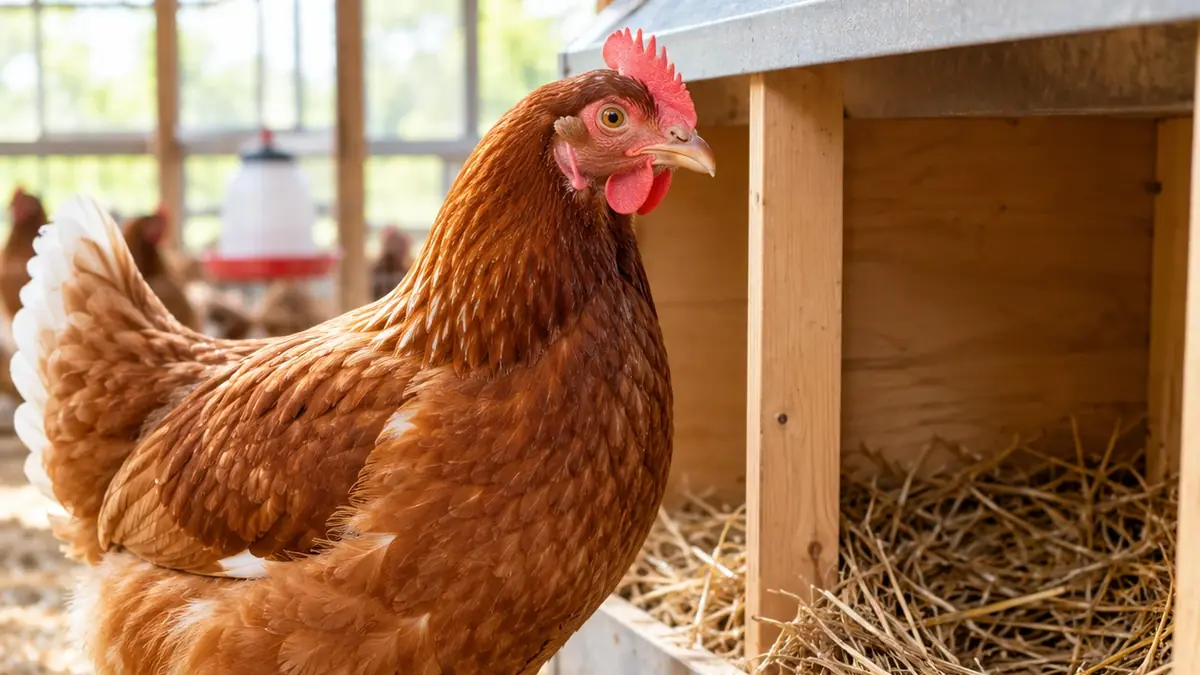

Twenty hens, twelve eggs a day. Some lay daily, some once a week, and some not at all while eating just as much. You can’t put each hen in her own cage, but experienced keepers don’t need to: a laying hen shows it in her body. The signs are described in culling guides such as Mississippi State University Extension’s and take a minute to check.
Five signs
| Sign | Laying | Not laying |
|---|---|---|
| Pubic bones | Flexible, two fingers or more apart | Stiff, close together, one finger or less |
| Vent | Large, pale, moist, oval | Small, dry, puckered, yellow |
| Comb and wattles | Large, bright, soft | Small, dull, shriveled |
| Abdomen | Soft and full | Hard or small |
| Pigment (in yellow-skinned breeds) | Beak, shanks and vent pale | Yellow color returning |
How to check
- Check in the evening, on the perch, in dim light — hens are calmer.
- Lay your fingers across the gap between the two pointed ends of the pubic bones on either side of the vent.
- Look at the vent and the comb.
- Mark doubtful hens with a leg band or paint and check again in a week.
The order of bleaching
In yellow-skinned breeds, the pigment that goes into the yolk leaves the body in a fixed order. It tells you how long a hen has been laying:
| Where it fades | After the start of lay |
|---|---|
| Vent | 4–7 days |
| Eye ring | 7–10 days |
| Earlobes (in white Leghorns) | 14–21 days |
| Base of the beak | 4–6 weeks |
| Tip of the beak | 6–8 weeks |
| Soles of the feet | 8–10 weeks |
When a hen stops laying, the yellow returns in the same order. A hen with white shanks in midsummer is a good layer; one with bright yellow shanks hasn’t laid for a while.
When not to rush
- Molt. A molting hen doesn’t lay but will come back in 8–12 weeks. A late, fast molt is the sign of a good layer (on molting).
- Winter and short days. Without extra light, the whole flock lays less (on lighting).
- Stress: a move, a predator, heat — laying recovers in one or two weeks.
- A pullet that hasn’t started yet shows similar signs.
If the whole flock has stopped, the issue isn’t individual hens — go through the causes in order in why hens stop laying.
Culling is an economic decision
A hen that isn’t laying eats 110–120 g of feed a day. If she hasn’t laid for a month or more without a clear reason, keeping her already costs more than she’ll return. When to replace the whole flock is covered in how long chickens live.
Culling in your records
In EggPulse culled birds come off the head count, and the laying rate is recalculated on the remaining flock right away. If the rate goes up after culling while total eggs barely drop, you removed exactly the hens that weren’t laying.