
A neighbor says: “Add sunflower oil to the mash — the broilers grow faster.” They add it, and the birds really do grow. Then a can of oil turns up that sat in the sun all summer, and a week later the chicks have diarrhea and three start falling on their sides and throwing their heads back. Oil in feed is useful — but only when it’s fresh and in moderation.
Why oil goes into feed
Oils and fats are the most energy-rich feed there is. A kilogram of vegetable oil gives poultry about 36.5 MJ (8,700 kcal) of metabolizable energy, while corn gives about 13.5 MJ (3,200 kcal). So oil has almost three times the “calories” of grain.
- Energy for fast growth. A broiler needs very “dense” feed: its stomach is small and it has to grow fast.
- Less dust. Feed with oil is less dusty, and birds spill less of it.
- Vitamin uptake. Vitamins A, D, E and K dissolve in fat. Without fat they’re absorbed worse.
- Egg size. Linoleic acid from vegetable oil helps a layer keep up egg weight, especially early in lay.
- In hot weather. Digesting fat produces less heat than digesting protein and grain. So in hot weather part of the energy is given as oil. More in the article on feeding in hot weather.
How much oil is used
| Birds | Added fat, guideline |
|---|---|
| Broiler chicks, starter | 1–3%, preferably vegetable oil |
| Broilers, grower and finisher | 3–6% |
| Layers | 1–3% |
| Pullets | 0–2% |
This is added fat on top of what’s already in the grain and meal. A ready-made complete feed is already balanced, and there’s no need to add oil on top: you’ll upset the balance of protein and energy.
Oil and protein go together
Birds eat “to their energy needs.” If feed becomes richer, they eat less of it. And with less feed they get less protein, calcium and vitamins. So when adding oil to your own mix, you also raise the share of the protein ingredient — soybean meal, oilseed cake. Otherwise the birds get fat but grow and lay worse. In layers, excess energy leads to fatty liver.
Which oils and fats are suitable
- Vegetable oils — sunflower, soybean, rapeseed, corn. Well digested at any age.
- Animal fat — beef, pork, poultry fat. Cheaper, but young chicks digest hard fat worse than oil. Better given to older broilers.
- Palm oil — solid at room temperature, digested worse by chicks than liquid oils.
- Used frying oil — better not to use. It’s already oxidized, and may also contain food scraps and substances from overheating.
How to add oil to your own mix
Oil spreads poorly if you pour it into a whole bag at once: you get greasy lumps and dry patches.
- Measure the oil by weight, not by eye.
- Mix it with a small part of the feed — about a tenth — until even.
- Add that to the rest of the feed and mix well.
Mixing more than 2–3% oil evenly by hand is hard. If you need more, it’s better to buy ready-made broiler feed. How to build a ration from your own grain is in the article on a ration from your own grain.
Rancid oil is poison, not feed
Oil oxidizes in air, light and heat — the more unsaturated it is, the faster. Oxidized oil:
- destroys vitamins A and E right in the feed;
- causes diarrhea and liver disease;
- in chicks causes vitamin E deficiency and brain damage: the bird falls on its side, throws its head back, spins;
- makes birds eat the feed less willingly.
A sharp smell of paint, linseed oil or fish, or a bitter taste. Cloudiness and sediment. If in doubt, don’t use it. In a lab, quality is checked by acidity: free fatty acids no more than 15%.
Storage
- Oil — in a closed container, in a dark cool place, out of the sun. Buy as much as you’ll use in 1–2 months.
- Feed with oil — use within 2–3 weeks, faster in hot weather. Minerals and premix speed up rancidity.
- Antioxidant. Commercial feeds and animal fat contain substances against rancidity. If you keep your own oil mix for a long time, bear this in mind.
How to spot other feed problems is in the article on mold and mycotoxins.
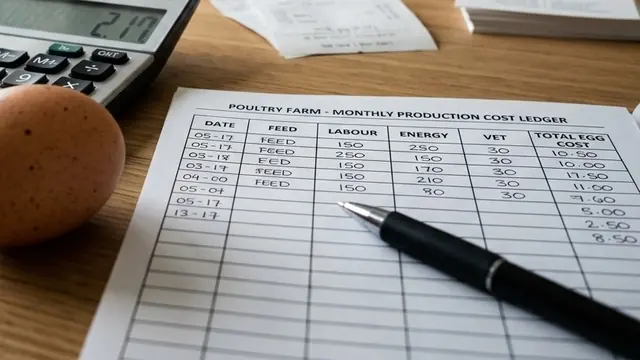
Oil in your records
EggPulse’s Feed ingredients guide has vegetable oil, palm oil, animal fat and fat emulsifier — with what each one risks. Oil is set up in stock as a raw material in its own category with a price, and a recipe shows how the mix’s protein, energy and price per kilogram changed. That way you see whether oil pays off at your prices.