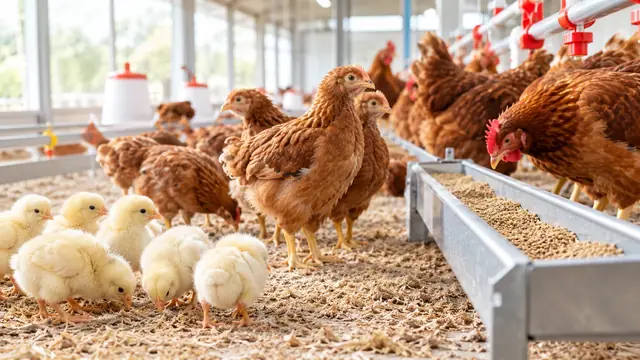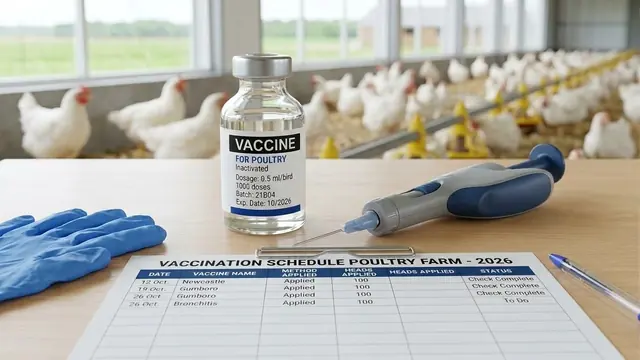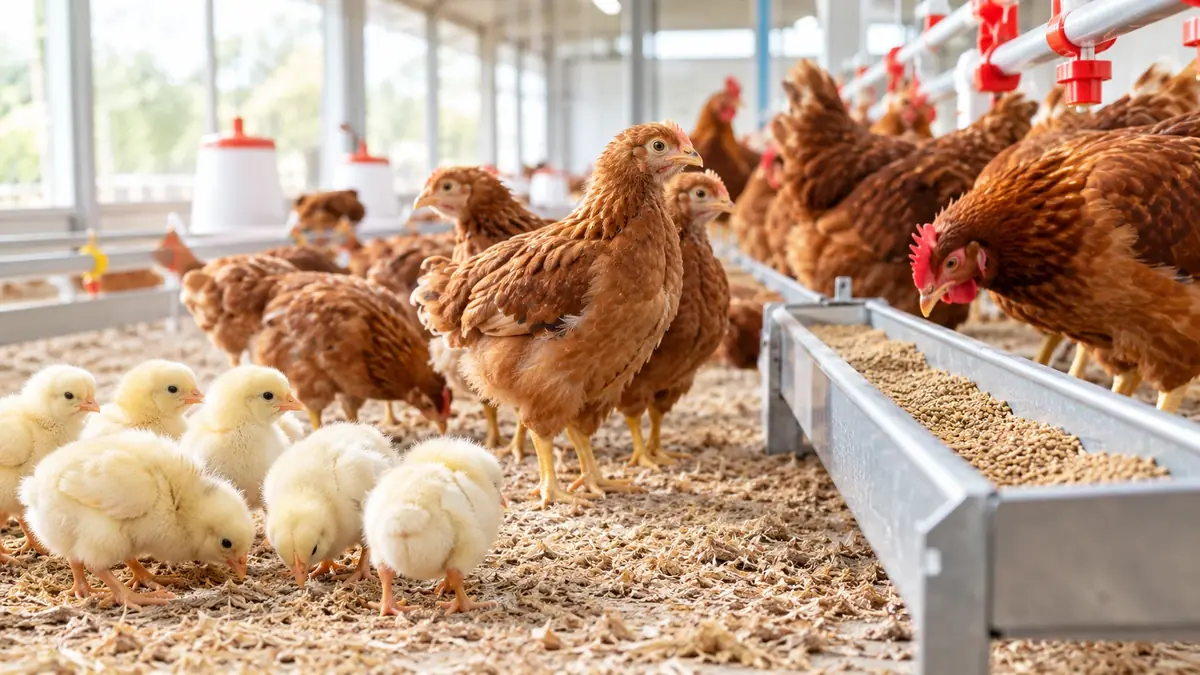

Many people keep chicks under light around the clock: “let them eat more and grow faster.” Broilers do eat, but by week four they start going down on their legs, and sudden death takes the biggest birds. Birds need night as much as feed: in the dark they produce melatonin, bones strengthen and the flock settles. A lighting program is a free way to grow a more even batch.
Broilers: the program by day
| Age | Light / dark | Intensity | Why |
|---|---|---|---|
| Days 0–7 | 23 h light, 1 h dark | 30–40 lux | Chicks find feed and water fast; one hour of darkness gets them used to lights going off |
| Day 8 to 3 days before slaughter | 4–6 h dark, at least 4 h in one block | At least 20 lux under EU rules; 5–10 lux in the Ross handbook | Legs, heart, even growth, less sudden death |
| Last 3 days | The EU darkness rule no longer applies | As before | Many farms keep the program unchanged until catching so as not to unsettle the birds |
The week-one and dark-period figures come from Aviagen’s Ross guidance; Cobb uses a similar scheme. The EU directive 2007/43/EC requires, from day 7 after placement until 3 days before slaughter, a 24-hour rhythm with at least 6 hours of darkness in total, including at least one uninterrupted period of 4 hours, and at least 20 lux at bird eye level over 80% of the area. If you work under EU rules, take 20 lux as the floor, not the 5–10 from the breed guide.
Pullets (future layers)
With pullets the goal is the opposite: not to push growth, but to stop them starting to lay before they’ve reached weight. The main rule in every laying-strain guide: never increase day length during rearing — only shorten it or keep it constant.
| Age | Day length | Comment |
|---|---|---|
| Week 1 | 20–22 h, bright | So chicks find feed and water |
| Weeks 2–7 | 1–2 h less each week | Gradually, no sudden jumps |
| Weeks 8–16 | A constant 9–12 h | In a closed house a fixed number of hours; in a house with windows, no less than natural daylight |
| Weeks 17–19 (at target weight) | Stimulation: +1 h, then 15–30 min a week up to 14–16 h | Only once pullets have reached the strain’s target weight |
The exact hours depend on the strain and on whether the house is closed to daylight. Managing the flock until lay is covered in raising pullets, and light for adult layers in lighting for laying hens.
Setting it up in practice
- A timer on the lighting circuit is the cheapest, most reliable automation. Lights go off and on at the same time even when you’re away.
- Gradual dawn and dusk with a dimmer: when lights cut out suddenly, chicks panic and pile up.
- Even light with no dark corners. In shadow birds eat less and peck each other more.
- Heat without light. If the brooder is heated by a red lamp, it shines all night and the chicks get no darkness. For the dark period you need a ceramic emitter or a heat plate (on brooder heating).
- A lux meter is inexpensive; phone apps measure light only roughly but are fine as a guide.
A night light, a gap under the door, a lamp in the neighbor’s yard — and the chicks don’t sleep. During the dark period, light should be below 0.4 lux: too dark for a person to read a newspaper.
Light and flock problems
- Leg problems and sudden death in broilers — more common under 24-hour light (why broilers go down on their legs);
- pecking — under light that’s too bright, especially white and uneven (on feather pecking);
- early lay and small eggs — when pullets got more light before reaching weight.
The program in your records
In EggPulse a batch shows weight, mortality and feed by day. Note in the log the day you introduced darkness or changed day length and compare with the previous batch: you’ll see how the program affected legs, mortality and evenness.