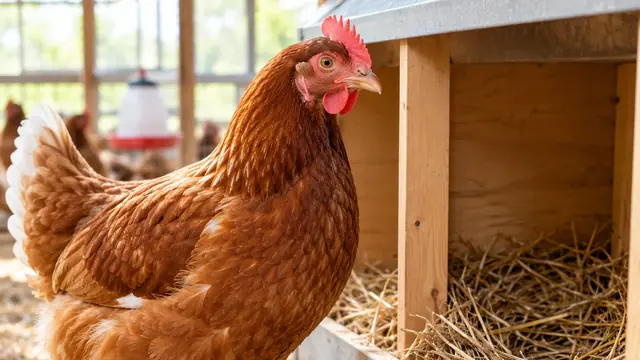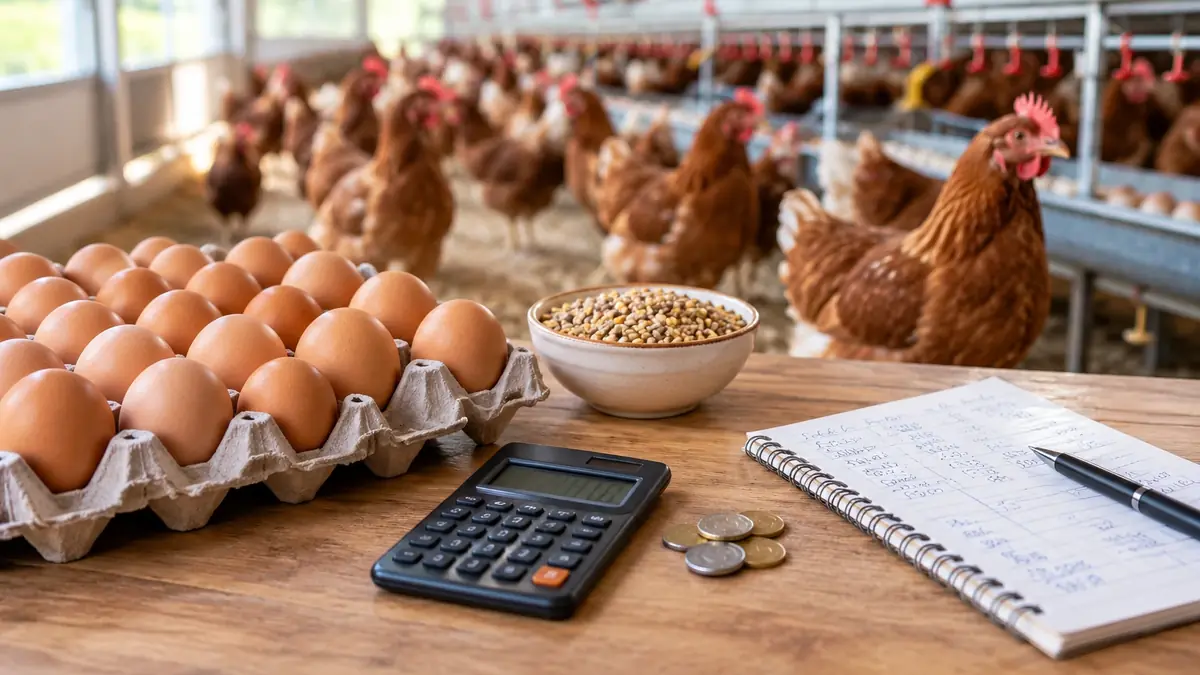

A house built for 100 hens holding 150 looks like a win at first: more birds, more eggs. A couple of months later come feather pecking, wet litter and floor eggs, and eggs per hen drop. Space isn’t a luxury; it’s the condition under which birds lay and grow the way the strain guide promises.
Layers: the European standard
The EU laying hens directive (1999/74/EC) sets minimums for barn systems that make a useful reference outside the EU too:
| Item | Standard |
|---|---|
| Stocking density | no more than 9 hens per m² of usable area |
| Nest boxes | 1 nest per 7 hens, or 1 m² of group nest per 120 hens |
| Perch | at least 15 cm per hen, without sharp edges |
“Usable area” is the space where birds can move freely, excluding feeders and nest boxes. For a small farm with a range it makes sense to keep fewer birds than the maximum: 4–6 hens per square meter of floor cope with a winter shut in noticeably better.
Broilers
The EU broiler directive (2007/43/EC) counts density by live weight, not heads: no more than 33 kg per m², or up to 39 and 42 kg when extra conditions on climate and record keeping are met. For a batch slaughtered at 2.5 kg, 33 kg/m² is about 13 birds per square meter at the end of growing. Plan the space by final weight, not by day-old chicks.
Other species
There are no single European space standards for ducks, geese, turkeys or quail. Follow the strain or breed guide and watch the birds: wet litter, pecking and falling behind on weight are signs of crowding. Specifics are in the articles on turkey poults, ducklings and starting a quail farm.
Nest boxes
- in a dark, quiet spot, not right under the lights;
- lower than the perches, or hens will sleep in the nests and soil them;
- with clean, dry nesting material — dirty nests mean dirty eggs;
- in place before lay begins: a hen used to laying on the floor takes a long time to retrain.
Perches
- smooth, removable, without cracks — red mite lives in cracks (on red mite);
- at one height or staggered like a ladder, so there’s no fight for the top row;
- a droppings board or mesh underneath, so manure doesn’t build up in the litter.
What crowding costs
Overcrowding almost never shows in the first month. It shows in the numbers: lower laying rate, more cracked and dirty eggs, higher mortality and more feed per egg. Compare those figures with what you had before adding birds — that’s the price of the extra heads (on weekly farm KPIs).
Even with the right floor space, birds can be crowded at the feeders. There should be room for all of them to eat at once — covered in the feeders article.
Space in the app
When you set up a house in EggPulse, the app suggests a typical stocking density for the species and housing type. The head count then changes with every mortality, culling and removal entry — so you see how many birds are in the house today, not on placement day.