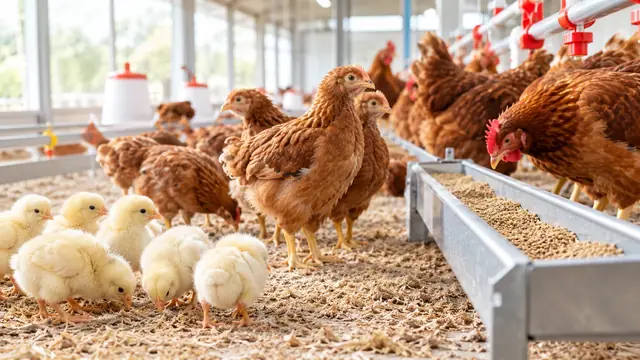

On a small homestead it’s tempting to fit everything into one shed: layers, a dozen broilers for meat, a couple of ducks and some turkey poults bought “to try.” The birds seem to get along, but by autumn the poults are dying one after another, the broilers’ legs are giving out, and the coop is always wet. None of the birds is at fault on its own. The trouble is that they’re cramped together.
Why different birds are kept apart
There are three reasons, and each is enough on its own:
- Different feed. A broiler, a layer, a duck and a turkey poult each need different feed. From a shared feeder, each eats the wrong thing.
- Different diseases. One bird can carry a disease without signs, while for another the same disease is deadly.
- Different conditions. A duck needs water to dabble in; chickens need dry litter. A broiler grows out in six to eight weeks; a layer lives on the farm for years.
Broilers and layers
The most common pairing and probably the least profitable. They share a feeder, but they need different feed.
| If everyone eats… | What happens |
|---|---|
| Broiler feed | Layers get fat, lay worse, and shells are thin: there’s little calcium in the feed |
| Layer feed | Broilers grow more slowly, and the extra calcium strains their kidneys |
| Grain “for all” | Bad for everyone: too little protein for growth and too little calcium for shells |
There are other problems too. Broilers are heavy and slow, layers peck them and chase them off the feeder. Broilers shouldn’t have high perches: jumping down hurts their legs. And broilers all go out at once after two months. Then the house needs cleaning and disinfecting, which can’t be done with layers inside. How to raise broilers as a separate batch is in the article on raising broilers at home.
Chickens and ducks
Ducks aren’t aggressive, but they’re wet. They rinse their bills in the drinker, splash water and flick feed out. In a day the litter around the drinkers turns to mush. Coccidia multiply fast in wet litter, ammonia rises, and the chickens start having foot and breathing problems.
The second problem is quieter. Ducks and geese often carry the avian influenza virus without getting sick themselves. For chickens the same virus can be deadly. If wild ducks visit your yard, domestic waterfowl become a bridge between them and the coop. More in the article on avian influenza.
If you must keep them together, at least give the ducks their own drinker on a grate over a tray, away from the chickens, and their own corner at night.
Chickens and turkeys
This is a dangerous pairing. Chickens often carry the agent of blackhead disease. It barely harms chickens. But turkey poults get very sick, and losses can be very high. The agent lives in the eggs of a small worm, which survive in the soil for months and even years.
- Don’t keep turkeys with chickens in the same building.
- Don’t put poults out on a range where chickens used to be.
- Do the turkeys first, then the chickens — not the other way round.
Quail, geese, guinea fowl
- Quail are very susceptible to ulcerative enteritis and to chicken respiratory diseases. Keep them separate, ideally in another building.
- Geese are large and quarrelsome. In the breeding season a gander can injure hens. They also need water and pasture, not a cramped coop.
- Guinea fowl get on with chickens more calmly than others. But they also need their own feed if raised for meat.
Different ages are different birds too
Even layers of the same breed but different ages are a risk. Older birds have been through many diseases and carry the agents while staying healthy: coccidia, Marek’s virus, mycoplasma. For chicks without immunity that’s enough to fall ill. So young stock are raised separately until they move into the main flock, at about 16–18 weeks. More in the article on raising pullets.
Visit the youngest and most sensitive first — chicks, poults, quail — then the adult hens, and the ducks and geese last. That way you don’t carry the diseases of older birds to the young ones on your boots and hands.
If space is tight
Not everyone has a separate shed for each kind of bird. In that case, at least:
- Divide the shed with mesh into separate pens, each with its own feeders and drinkers.
- Separate the runs, especially for turkeys and chickens.
- Footwear and tools — separate for each pen, at least a separate pair of overshoes.
- Raise broilers in batches in the warm season, in a separate pen or a temporary house, not in the coop with the layers.
- Watch closely: if losses start in one pen, don’t carry anything from it into the next.
Different birds in your records
In EggPulse each house has its own bird species, and the app uses weight and feed norms for that species. If layers, broilers and ducks live in different pens, set them up as separate houses. Then feed, mortality and costs don’t get mixed, and you can see which birds on your yard actually make money.