
Six weeks — and a 40-gram chick becomes a three-kilogram bird. No other animal on a small farm grows so fast, and none forgives so few mistakes: a lost day in week one shows up as missing weight at slaughter. Below is the whole cycle of one batch, week by week, with links to detailed guides for each step.
Before the chicks arrive
- The house is washed and disinfected, dry, with 5–8 cm (2–3 in) of litter (how).
- The brooder is built for the number of birds, heating tested, with a backup heat source (brooder plans, how many watts).
- Heat switched on a day ahead, so floor and litter are warm.
- Feed bought for the whole batch or deliveries arranged: 0.3–0.4 kg of starter per bird and about 4 kg more of grower and finisher (on phase feeding).
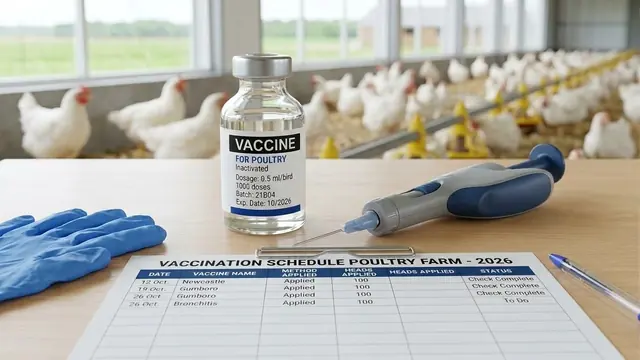
- Hatchery chosen, and you know which vaccinations have been done (what to ask).
The plan by week
| Week | Temperature at chick level | Light | Feed | Ross 308 weight at week end | Key point |
|---|---|---|---|---|---|
| 1 | 33 → 30 °C | 23 h, bright | Starter crumble | 213 g | Crops after a day, mortality no more than 1% |
| 2 | 30 → 27 °C | 4–6 h darkness | Starter | 533 g | Expand the brooder, Gumboro vaccine per schedule |
| 3 | 27 → 24 °C | 4–6 h darkness | Grower | 1,012 g | Remove the brooder, Newcastle booster per schedule |
| 4 | 22–24 °C | 4–6 h darkness | Grower | 1,616 g | Ventilation and dry litter |
| 5 | 20–22 °C | 4–6 h darkness | Finisher | 2,296 g | Legs, heat, coccidiosis |
| 6 | 18–21 °C | 4–6 h darkness | Finisher | 2,998 g | Decide the slaughter day |
Details for each column: lighting program, feed by day, weight by day, vaccinations.
The first week decides everything
- feed and water from the first hour, drinkers at the edge of the warm zone (on the first water);
- after a day — full crops in 95% of chicks;
- chick behavior is the best thermometer: spread evenly through the brooder — good;
- day-7 weight about 200 g; a week-one shortfall is never made up by slaughter;
- mortality into the log every day — the day of death points to the cause (why chicks die).
Weeks two to five
- Space. By the end, no more than 30–33 kg of live weight per m² (about 10–11 birds of 3 kg); crowding means wet litter and leg problems.
- Feeders and drinkers are raised as birds grow: the rim at back height (on feeders).
- Water. A broiler drinks almost twice what it eats, more in hot weather (on water use).
- Weigh weekly — 20–30 birds from different spots.
- Warning signs: blood in droppings — coccidiosis (on diarrhea), rattling breath — a respiratory infection (on wheezing), birds sitting and not getting up — legs (on legs).
The last week and slaughter
- a big broiler is hardest to keep in the heat: ventilation, water, feed in the cool hours (on feeding in the heat);
- the slaughter day is worked out in money: in week seven a kilogram of gain already takes 2.2 kg of feed (when to slaughter);
- if the birds were treated, respect the withdrawal period;
- feed out 8–12 hours before, water stays (on slaughter and processing).
A good small-farm batch: mortality under 5% for the whole grow-out, weight at 42 days 2.6–3.0 kg, conversion 1.7–1.9. If your numbers are worse, that’s not a verdict but a list of what to fix next time.
What it costs
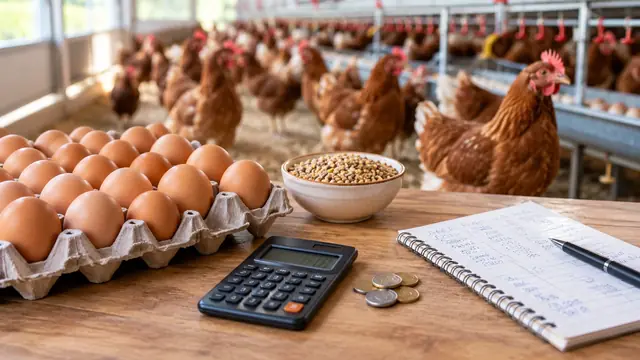
Feed is about half of small-farm costs; the rest is chicks, heating, bedding, vet care and mortality. A worked example for a 100-bird batch with a break-even price is in what it costs to raise a broiler.
The batch in the app
In EggPulse a batch is created with its placement date, head count and strain; feed, water, mortality and weighings are logged by day, and the app plots weight and feed targets for your strain. At the end you see conversion, cost per kilogram and a comparison with the previous batch — where planning the next one begins.